
May 1, 1994: Seer Green To Cookham Rise
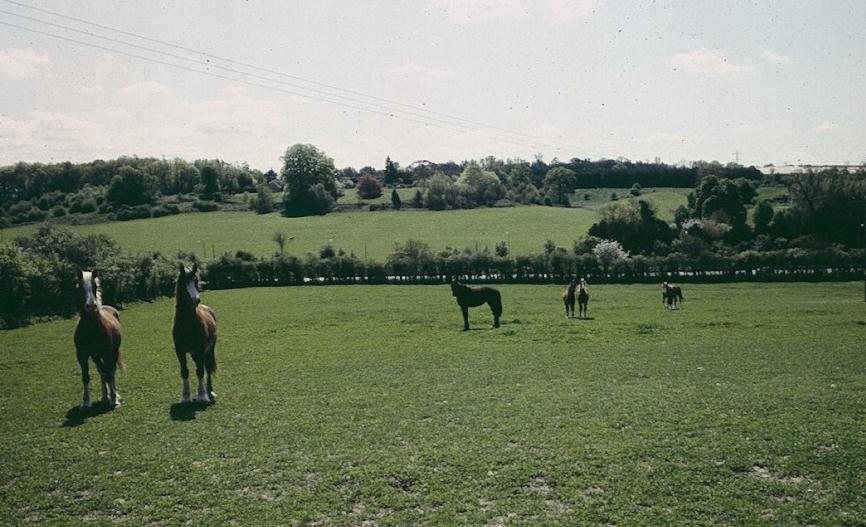
Horses in the field above the A40
On May 1, 1994 we returned to the Chilterns Hundred, our small party augmented this time by my wife Dorothy. We met the Lees at Marylebone Station at about 9:20. They had arrived early and had already left the station to seek an open coffee shop. Everything in the station itself was closed – even the loos.
It was a lovely Sunday morning, the middle day of a three-day bank holiday weekend, and I was already quite red from a day in the sun at the opening celebrations for ASL’s new Canons Park property the day before. Today I would wear my baseball cap low on my brow to prevent further exposure to the top of my head. But it was t-shirt weather – so once again I advertised the wonderfulness of the Michigan Neighborhood Alliance.
About forty minutes worth of intense ASL gossip, dominated by the recent resignation of principal Clayton Lewis, got us to Seer Green, which we had last visited on March 17. Toby, encased in his purple harness, was a real pest on lead this morning, resisting all attempts to get him to heel properly as we walked against the oncoming traffic. But there wasn’t too much of this as we headed back to the borders of Jordans village and turned right on Welders Lane. This place had been the subject of much interest in the local news of late – following the unsuccessful attempts of a grumpy resident to have cricket barred from the village green after a few balls had bounced into his garden. We never penetrated the village itself, only its Quaker and Youth Hostel outskirts, before reaching a hedged lane heading in a southeasterly direction.
I was paying very close attention to the written description in our guidebook, but some of the details were no longer obvious on the ground. I had also studied the route on the OS map, and I was able to keep us moving with a number of compass readings on the required bearing – in spite of the absence of the advertised isolated stile or any path leading directly across an open field. Instead we used a track for a bit, then found a path that reached the edge of Great Leas Wood. A sharp left was needed once inside the wood in order to place a deep hollow on our left as we ascended a hill on a very faint, wet trod. I was very relieved to emerge at the top opposite the corner of a meadow, with the path we were looking for leading off along its right hand side. At the end of the meadow we re-entered a woodland, carpeted with bluebells, and continued on to a metaled road at Layter’s Green. Bluebells blossomed in profusion in every wood today, a lovely sight.
We didn’t see much of Layter’s Green, continuing behind houses on a hedge-in lane and turning in a southwesterly direction after climbing a stile. A series of paths took us into the woods and here, although it was quite early, we decided to break into the provisions and have some lunch. I ate an egg salad sandwich and some crisps. Toby had a hard-boiled egg and warned us of approaching walkers as we sat on some stumps amid dry leaves.
Then we continued forward up to a farm road which crossed our railway line. Our route then led out to another metaled lane – where we turned left, past the Manor House, and turned right to enter a field. There was no stile here, but we were able to push open a farm gate to gain access. Our activity was detected by a dozen or so horses, including some babies, and their presence soon excited the nervous dog. He was back on lead, of course, but he let out several barks of protest when these beasts got too close. They were certainly curious about our intrusion into their space and as we descended steeply toward the A40 in the valley below the animals crowded around us. I found it a rather comical scene. I was trying to take pictures, which means I was trying to get the other walkers to hold their pose, a problem for them since the eager horses nudged them forward several times with their noses – Dorothy squeaking in protest as she lapsed into her Red River stampede mode. I think we were all glad to escape the attentions of the Equus crowd as we climbed a stile and dashed across the busy highway.
We had to walk around between two bungalows and enter a gently rising bare field, searching out an iron swing gate at the top. Once again it was not too easy for me to figure out the route. We turned left along a wire fence and climbed up to a rubbish tip. This remained on our right as we rounded its perimeter, using a grassy track next to a line of fir trees. There was some confusion over the next section and I even did some unnecessary backtracking in an orchard before we continued forward with our backs to the tip and into a copse where someone had stored a huge boat in his backyard. We followed a track toward some power lines, but when we reached them there didn’t seem to be much that resembled the route description; with so many quarries and dumps about it was obvious that man had made a mess of the terrain. I knew that we had to keep moving in the direction of the M40 and we continued forward on to the road to Moat Farm; soon after passing this collection of houses we found ourselves looking down at the whizzing Sunday traffic of the motorway.
At the far end of our overpass we escaped via a stile on the left and descended into someone’s backyard. A stony track put us on a minor road into Hedgerley Green. This seemed to be quite a charming hamlet, with ducks in its several ponds. There was a debate here about living in the country (instead of just walking through it). Dorothy said it wasn’t for her and Harold agreed that more than a day or so out here would drive him spare. Thinking of a remote Lakeland resting spot I said, “But I thought you recommended Overwater Hall as the perfect place for a nervous breakdown.” “Yes,” he said, “but more than a few days in the country would give me a nervous breakdown.”
Our route now led in a westerly direction through woodland. When we emerged from its shadows we had a wonderful view of the late blossoming trees surrounding Hedgerley village. A drop down to the church was followed by a stroll onto the main street; to our delight we discovered the White Horse pub on our right and in a few minutes we were supping our lager in the extensive back gardens – full of families, dogs and a kitchen boy who collected glasses and threw garbage over the wall.
We didn’t linger for long, but the Lees had forgotten their digestive biscuits and before we left they tired to buy some more snacks, unsuccessfully, at the bar. We had no better luck at the Brick Mould, a second pub a few yards to the south – where we turned west for an extended sojourn along quiet country lanes. We crossed over Andrew Hill Lane, where I paused to take a photo of the road sign in honor of our school’s student council vice-president, another Andrew Hill. Then we passed through Pennlands farm on a track, reaching the A355. Here a half left put us onto a delightful path through a corner of the famous Burnham Beeches. Again I wasn’t too confident that I could identify all of the sites mentioned in the text but we persisted in the right direction, walking sometimes next to the boundary fences of open fields and emerging at tarmac again after reaching Abbey Park Cottage.
More road walking followed and, just a few minutes before the last orders bell sounded at 3:00, we reached the Blackwood Arms Inn at Littleworth Common. As at the White Horse I never penetrated the interior of the establishment (which seemed to be without any running water today), preferring to stay outside with the dog, here on a patch of shaded grass in front of the pub. I had another half lager while Tosh hammered away relentlessly on the theme of my giving up some of my current ASL responsibilities – now that it had been confirmed that I would be English Department chairman next fall. I have to say that I was growing weary with all the school talk – the walk is supposed to be an escape from the work world.
It was now quite warm and, as we continued in a mostly southwesterly direction, Toby was running out of steam. I made sure that he got plenty of water but we were all slowing down as we neared the final stretches of this ten and a half mile jaunt. There was a lot of road walking and a good deal of Sunday traffic to dodge as we cleared Bristles Wood, passed Hales Cottage and marched along farm tracks and bridleways. After passing Hedsor farmhouse we turned left at the entrance to Woolmans Wood where, after a pause for a pee and a look at the next page of the guidebook, I directed us down the Church Path, itself crowded with Sunday strollers. There was a marvelous thatched house at the entrance to Hedsor Priory.
We turned right and passed through a field dotted with scrambling rabbits. Keeping to the left of a meadow we were soon on the banks of a slow moving green expanse of water, one that I knew to be the Thames itself. As we headed across an onion field to the A4094 an elderly gentleman tried to get advice on the towpath hereabouts – noticing that I was “from across the pond” in the process. In fact we couldn’t really help him, since our experience of the area, on both the Thames and London Countryway routes, had been on the other side of the river.
The two earlier walks had put us into Cookham, which we now approached from a third angle as we inched across the narrow bridge from Bucks to Berks – with Dorothy carrying Toby for safety’s sake. We turned west a bit too soon, getting ourselves trapped in the church car park, and then retraced our steps to Cookham’s main street, where we turned right again on the pavement that brought us past a long series of shops –including Pauline’s confectionery, where our dog Bertie had received a biscuit during our first visit to the town, almost a decade earlier.
We were heading uphill to the train station, not a particularly charming mile since there was often no pavement, only a great deal of traffic and many pedestrians. Tosh paused to get the others ice creams, which I disdained. We had timed our arrival so that we had only a few minutes left before the 5:28 shuttle to Maidenhead arrived. The Lees took the connecting train, which was late, only as far as Ealing Broadway, and we continued on alone, a tired dog asleep on our laps, to Paddington – after a lovely outing.
To continue with the third day of our walk you need:
Day 3: Princes Risborough to Wendover
The route itself would have continued from Cookham to Marlow but we did not walk the Parsons route since it replicated sections of both The London Countryway and the Thames Path between these two towns – and we had therefore already walked this section twice. An account of this portion of the route can be located however in sections devoted to The London Countryway and The Thames Path elsewhere on this website – see Day 5 in both instances.
In the case of the LCW see:
In the case of the Thames Path see: