
June 14, 2008: Knighton To Llangunllo
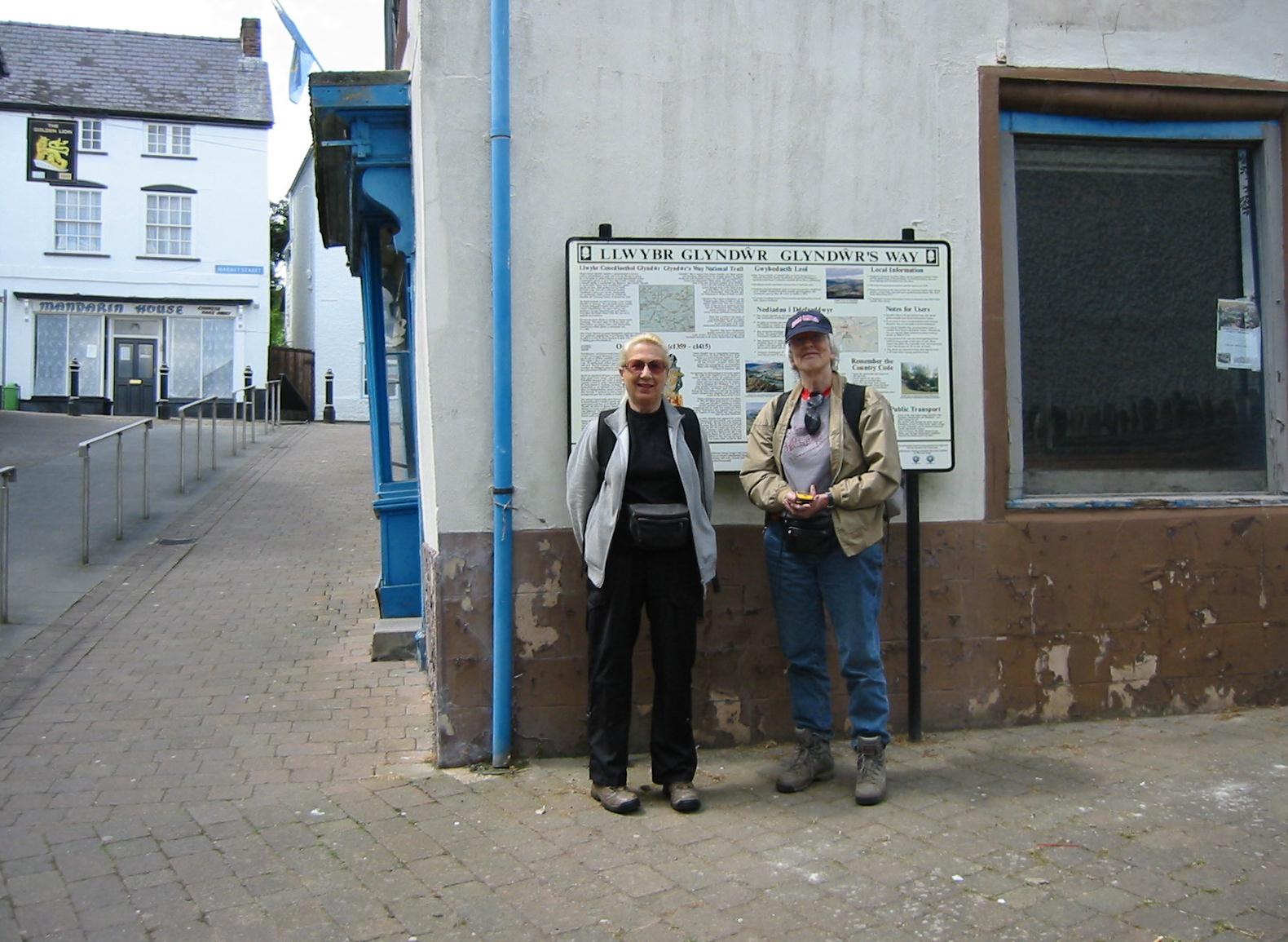
Margie and Tosh at the start of the route in Knighton
At 7:00 on the morning of Saturday, June 14, I climbed into a minicab for the short journey to Paddington Station – it was again time for one of our weeklong walking journeys.
Sadly, our usual numbers were, by now, much diminished. Although, in 2005, Tosh, Margie and I had walked all but one day of the Dales Way without Harold, he had been able to return to the trail, some months later – after the injuries sustained in Wharfedale had healed. Indeed, he had been a successful participant in our Lakeland expedition the following year. But that October he died in Morocco and our expeditions would never be the same. Ironically, it was not until his memorial service on December 3rd that I realized just how ill my wife Dorothy was. A Glyndwr’s Way trip that Marge, Tosh and I had scheduled for June 2007 had to be cancelled at almost the last minute – when her condition deteriorated markedly. She died on July 12 and, of course, there was no summer walk in 2007 at all.
Today’s endeavour was an attempt to revive something of the old rhythm – but it was with a marked melancholy that we attempted to revisit our old ways. Harold and Dorothy were so often the topic of our conversation and I could feel her hand gripping the back of my knapsack every time there was a steep descent on Glyndwr’s Way. Today would have been our forty-fourth wedding anniversary.
I had plenty of time in Paddington and, heavy pack on back, I wandered outside in search of a chemist. Once again I was starting a trip with an injury, though in this case it was presumably a minor one, a sore spot inside my right nostril! Not one of the local chemists was open – nor was the Boots inside the station – so perhaps I would have to make do with the array of nostrums I had secreted in my pack already. Here too was located the collapsible cane that I had purchased for Dorothy – I had been experiencing considerable difficulties with my legs, the consequence of a long struggle against the resistant strands of a whole field full of oilseed rape – encountered on what was supposed to be a Chiltern Way conditioning walk two weeks earlier.
Tosh and Margie appeared soon after I returned to the station and we boarded the 7:45 for Newport. We were about to begin one of those desperate journeys needed just to get ourselves into place for half a day’s walking in Wales: two trains, a bus (actually a replacement for a third train) and a taxi ride. I had purchased tickets to Ludlow some two weeks earlier and we now had seat reservations – indeed we handed the confused ticket guard these instead of our actual tickets as we began the long walk down the platform.
The weather was bright and the train made only a few stops so that by 9:30 we were already climbing off our first train; we had once spent a night in Newport – on the eve of our second expedition on Offa’s Dyke Path. Now there was time for cappuccino and muffins in a station coffee bar and then we headed north on the Hereford train at 10:04. There were people in our reserved seats and so we took others in a crowded compartment in which we were serenaded by the musical preferences of a cretin with a CD player. The patient conductor ploughed through the carriage, politely explaining to the customers why they couldn’t complete their journey without the assistance of replacement buses today: engineering works.
Some of these folks joined an anxious queue in front of the station at Hereford as every bus driver in the vicinity was asked if he were going to Ludlow. Finally the right vehicle appeared and we dragged our packs aboard for a forty-five minute journey. Teenagers discussed rendezvous points with one another on their mobile phones – a task made more difficult by the total absence of any knowledge of their own local geography.
When we got off the bus in Ludlow I made quick contact with a lady taxi driver whose firm, Trev’s Taxis, I had phoned two days earlier. When we had last arrived in Knighton on a walking outing, that is in 1988, you could leave London and arrive in this Powys border town in time to complete a full day’s walk. Today the earliest train from London arrived in the late afternoon and that is why we were now speeding (and I do mean speeding) westward in a taxi. I used the first few minutes of this journey to alert our first landlady of our imminent arrival on my mobile phone – it would be days before I could get a signal again on this instrument in hilly Wales. Now we could arrive at midday, stow our packs at our b&b, have lunch, and still have time for an afternoon’s walk.
Things went well until we reached Knighton itself; locals had to provide complicated instructions on how to find the Fleece House on Market Street, an uphill battle on one-way streets – one of which was blocked by a lorry which spent five minutes hoisting a skip onto its back.
It was 12:30.
We were welcomed by Mrs. Simmons, a Polish lady, and shown to our en suite rooms (three in this case) in a well-appointed and tidy establishment. I don’t think any of us could take in all of the rapid-fire instructions on the use of the showers, but that did not deter us from completing the rest of our noontime ritual. (Later Tosh discussed plumbing and fire doors with every one of our landladies – as she was about to undergo a loft conversion back home.)
At the bottom of The Narrows we discovered the clock tower (covered in scaffolding), an edifice that marks the official start of Glyndwr’s Way, also a notice board and a slate memorial on the same subject. We found a comfortable pub, the George & Dragon, and settled in for drinks and lunch – I had a chicken korma. The pub was presided over by a lovely little shorthaired Dachshund named Holly and the staff were quite pleasant. I darted out after giving my food order and rounded a corner where I knew I could find a chemist. The man in charge informed me that he had nothing on sale that would be of any use to my nose – without a prescription. I did have one success across the street – making a reservation for our evening meal at the Horse & Jockey. We had a nice lunch (Holly got a few pieces of poppadom) and at 1:50, ten minutes earlier than programmed on this day of great planning complexity, we were ready to begin our walk on Glyndwr’s Way.
I had acquired some pamphlets about this C-shaped route many years earlier but my interest in actually getting a foothold here had peaked only with the elevation of the route to National Trail status and the listing of accommodation in the Offa’s Dyke Association b&b booklet. In the event I decided to let a professional body, Celtic Trails, handle all of the bookings and the inevitable transfers to and from the trail – travel made all the more necessary because I wanted to shorten some of the stages that this company usually schedules. The only change I had made to this afternoon’s march was in our pick-up time in Llangunllo, six and a half miles hence. They had arranged for Knighton taxis to pick us up at 5:00. I had called to change this to 6:00.
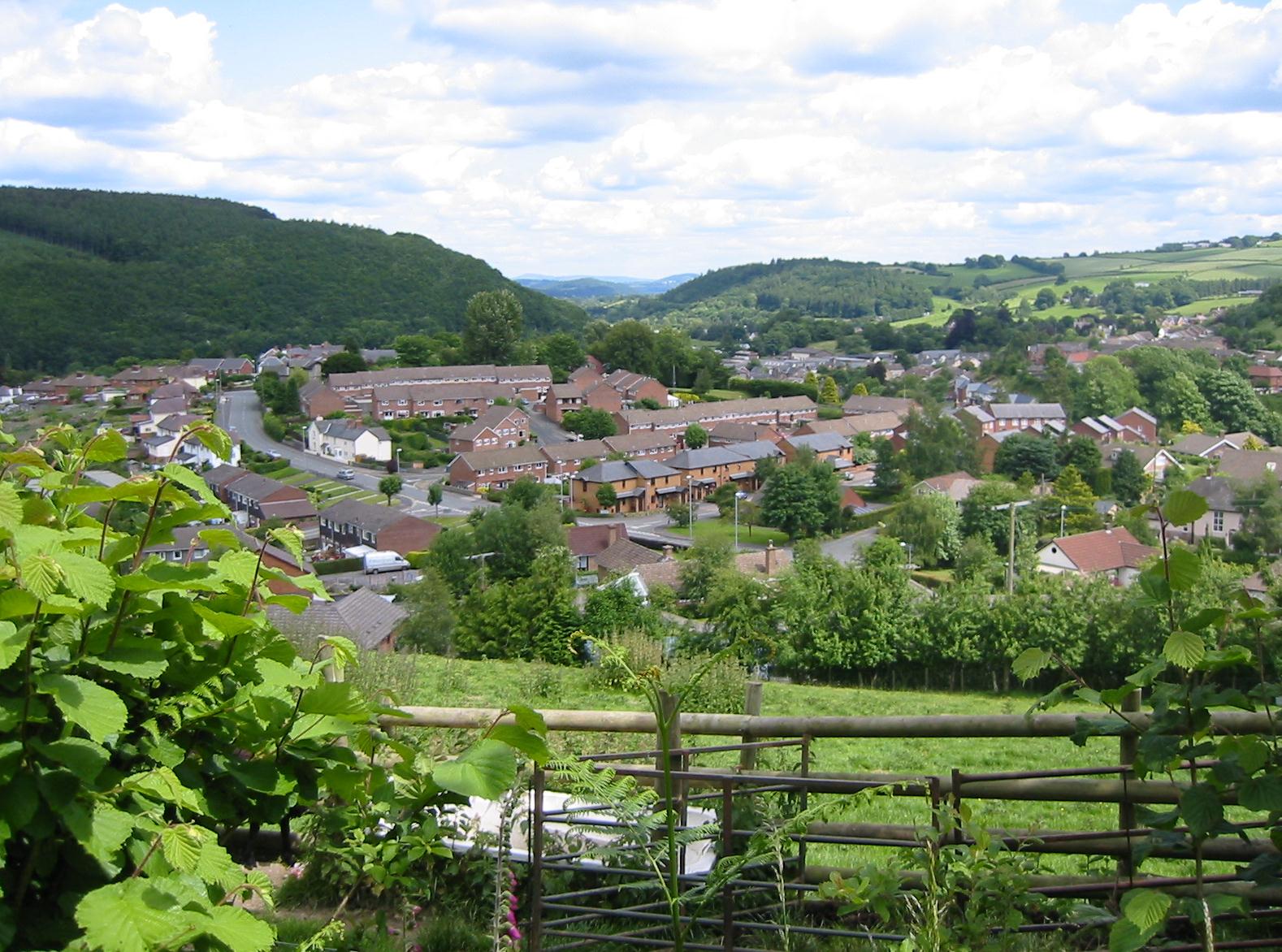
A retrospective view of Knighton
Ready at last for the off, we left our pub, re-climbed The Narrows, and, having reached the Fleece again, turned left at the Golden Lion – walking along Castle Street and turning our backs on Knighton almost immediately. A valley was soon below us on our left and we began a descent to streamside, flower-bedecked cottages accompanying our route for some time. A first ascent began as we were joined by a lane at Mill Lodge and thus we reached an outpost of suburbia at a road – where we did a brief dog-leg to the left before continuing steeply uphill to reach yet more houses.
Back in my study it had been difficult for me to link the instructions in David Perrott’s National Trail Guide with the OS maps tucked therein, and it was a pleasure to see how it was all working out on the ground. The great deficiency in this otherwise very useful publication was the lack of mileage markers; I had painstakingly added these myself so that I could measure our progress exactly. The reputation that the route had as a well-waymarked one was bearing out; its reputation as a strenuous activity was still to be tested – but I felt I had given us plenty of time to get to Llangunllo, and so we adopted a quite peaceful pace, especially in the first few hours.
It was a warm afternoon (I was walking in t-shirt only) and so it was not entirely unwelcome that Glyndwr’s Way began a long section on a track that turned from north to northwest on a wooded shelf high above the Teme Valley on our right. It was a little hard to know exactly how far we had come as we surmounted stiles and pushed through gates; at one point I called Tosh back so that she could share my discovery: the sight of Offa’s Dyke Path as it climbed Panpunton Hill on the opposite side of the valley – our route twenty years ago. We left Knighton behind us – the sounds of the “Just One Cornetto” song echoing from a distant ice cream van.
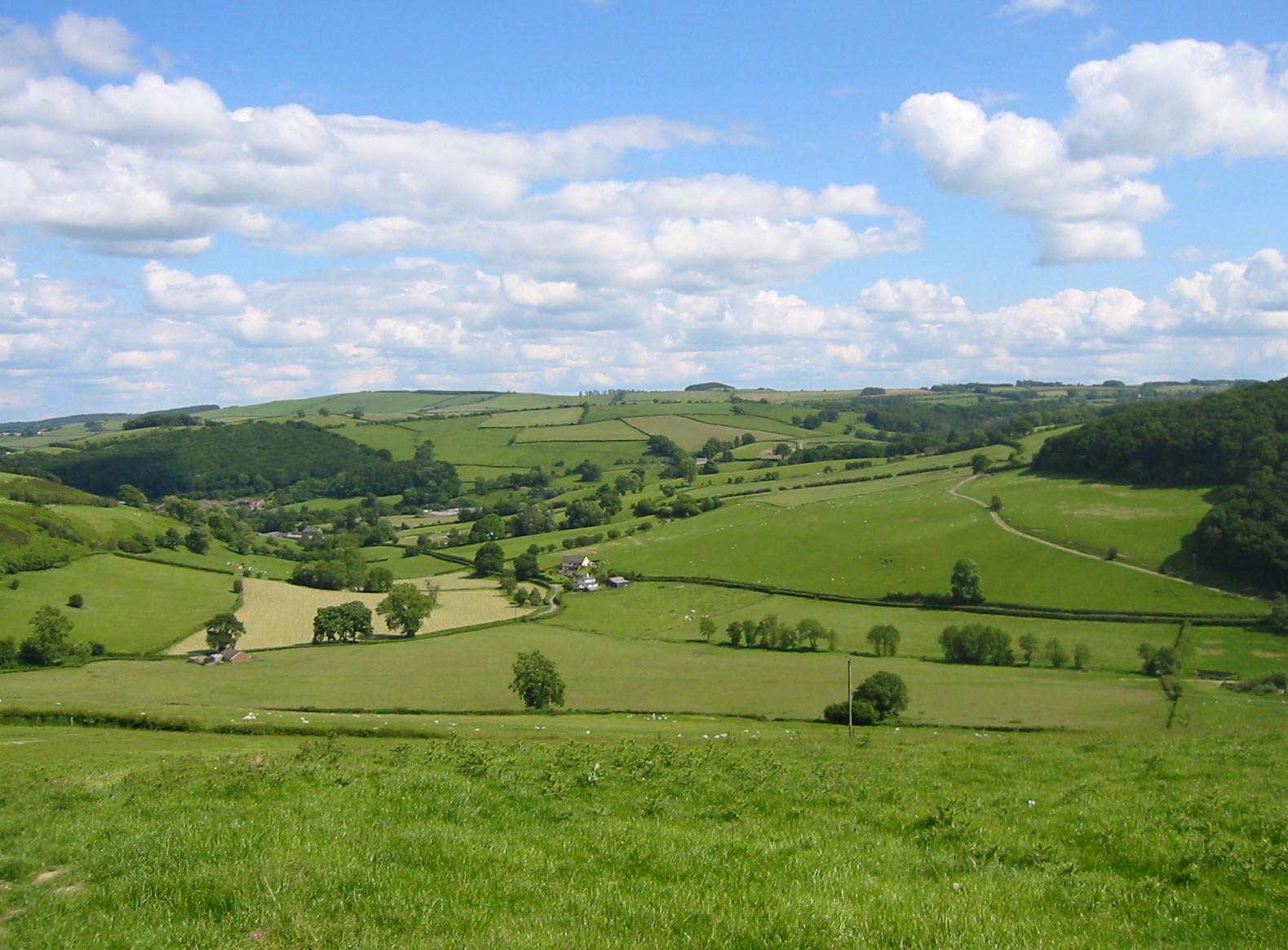
Looking southeast from the summit of Bailey Hill
We marched below the summit of Garth Hill for the better part of a mile but at last we emerged onto a lane in sunshine and turned left for the beginning of a stretch of road walking. Fortunately there wasn’t much traffic (something that could be said of all of the road walking we did in Wales on this trip). We soon reached a junction and turned south to begin a descent on tarmac – with fields of buttercups on our right and after half a mile we turned off at the access road to Little Cwm-gilla farm. A long and occasionally very steep westward ascent began here. I saw none of the promised wild strawberries in the hedgerows here but it was soon obvious that the dominant flower of the moment was the foxglove. We paused for breath at Ebrandy House and kept climbing, with views improving all the time until we had almost a 360 degree view, from Bailey Hill, of fields and farms, hedgerows and plantations, all beneath beautiful cloud-filled skies. It was exhilarating.
Tosh was out in front for much of this, but increasingly I took the lead, particularly as I began to see that our slow progress was imperilling out 6:00 rendezvous time. After a little bit of up and down we reached a turnoff point (not as well waymarked as I would have hoped) and I made a sharp left turn, eventually finding evidence that we were still on route. Truth to tell, there had been several alterations to a number of gates and fences hereabouts and Glyndwr’s Way was now sharing the space occupied by sheep pens – enclosures in which a large flock had to be displaced by our boots as we reached for the next stile.
After clearing this menace (and with a word from me on picking up the pace) we began an easy descent in territory dominated by old quarry workings and forestry. Above us an old quarry road was serving as a training ground for hurtling cars, a cloud of dust falling through the air at each whining passage. Fortunately we were not asked to join this road but to begin a steep descent to a streambed, which we crossed. Now our route followed tracks and paths in the direction of Cefn-suran, a large farmstead that I had once hoped might offer b&b accommodation at the end of our first night; evidently it and all other accommodation possibilities near Llangunllo had been withdrawn. We were offered a thin path to the north of the farmstead and then tracks that lead us up a hill – where there was some ambiguity over the right line to take to reach a rural roadway.
Our path now continued just a few yards before reaching an open hillside; the downhill route was very steep and hard on the toes. It was now easy to see where we were to go and soon we were back among the houses adjacent to the Llangunllo road itself, where we turned right. I could tell that we were going to make our rendezvous on time and so I slowed us down a bit. We passed a rally driving school (that was homework we had experienced before) and entered the little village where, sad to report, the first sight that greeted us was the “for sale” sign on the Greyhound pub – whose proprietor had died. The second sight, near the war memorial, was the taxi of Mr. P.A. Lewis, the proprietor of Knighton Taxis. He was ten minutes early (it now being 5:50) and we were soon aboard for our ride back to Knighton.
I had been seeing adds for this taxi company on the back of my ODP publications for years, so it was nice to see the source of this copy at last. Mr. Lewis said that he had a very busy night ahead because the Young Farmers were holding a barn dance nearby. He also advised us on the delights of the vodka marmalade provided by our landlady – but we did not return immediately to her rooftops for I suggested that we stop off first at the George & Dragon again for a celebratory drink. This we did – Holly was asleep in her basket in the hall and the bar crowd was getting ready for a night of European championship football, an event that lacked its usual excitement for many – since England had failed to qualify.
After our drinks we climbed The Narrows again, removed our mucky boots (Mrs. Simmons gave me a brush so that I could chip off some of the offending matter at the curb) and then we went to our rooms for showers and a little rest. At 7:50 we met up again for a walk to the bottom of the town again, enjoying a nice meal at the Horse & Jockey (I had the battered cod) and then dodging the coachloads of rural revellers on their way to the barn dance. These folks were not to blame for the noise that invaded my room, however; unfortunately I was situated adjacent to the pavement where the Golden Lion crowd and other latelings chatted on their way home – as late as 2:00 in the morning.
To continue with the next stage of our walk you need: