
June 18, 2010: Pont Llogel to Meifod
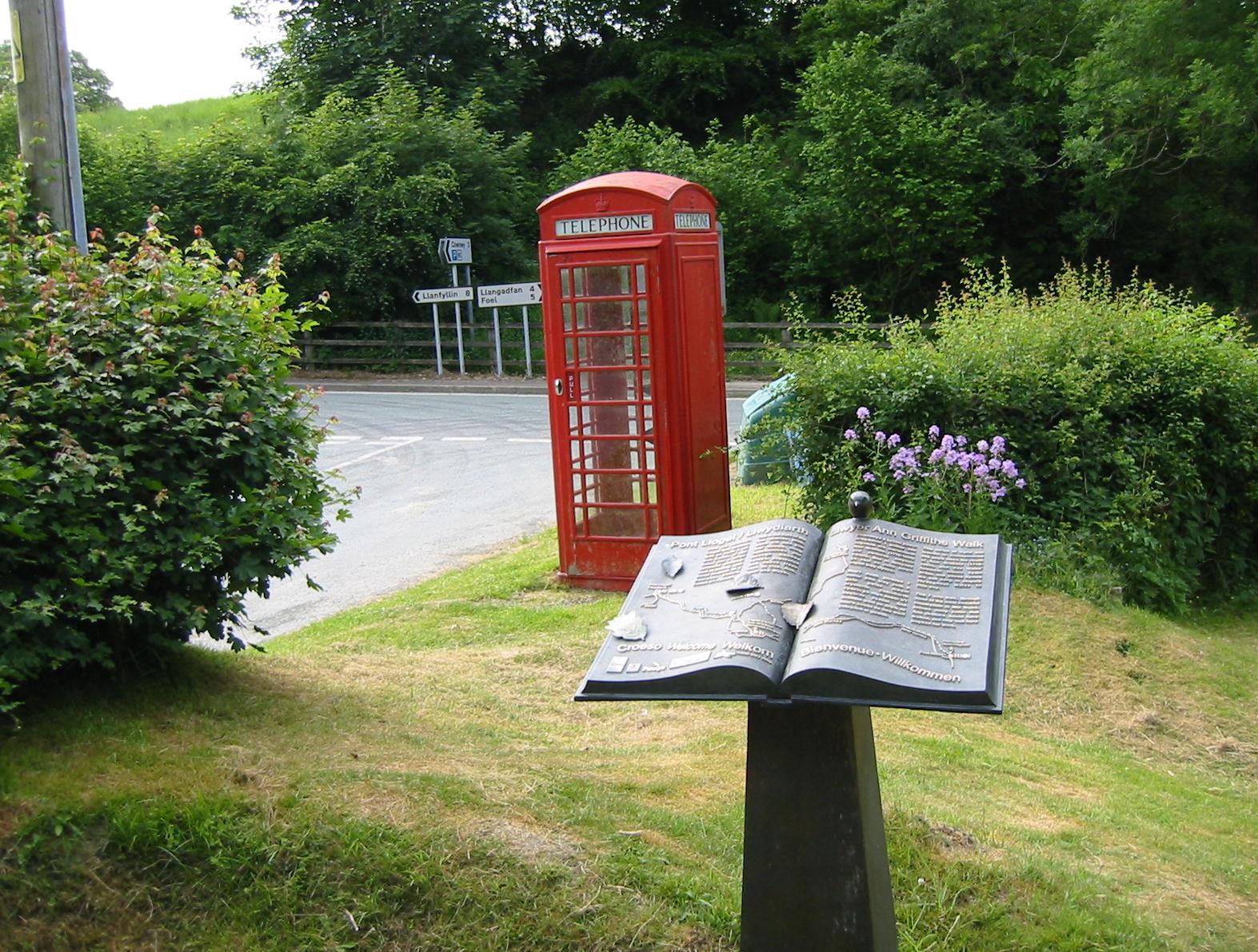
The Anne Griffiths plinth and telephone call box at Pont Llogel
I was expecting our longest day today and so I made an effort to get us moving early again. For me there was a slight delay – as my Ipod earphones had fallen into a crack next to my bed – and had to be retrieved. We had breakfast at 7:30 – with honey from Mrs. Gilson’s own hives a feature. The ride back to Pont Llogel did not seem to take quite as long as the ride out, but Mr. Gilson again had a chance to continue the lecture: snowed-in for three weeks last winter, he had the energy to plough out his long driveway only once. He also described how he gives tours of local graveyards for visiting Americans, eager to make contact with ancestors left behind. Soon we were back in the parking lot next to the red telephone box. Mr. Gilson said he hoped we would not be too hot in the sun or too wet in the rain and then he drove off. We discovered now that a bronze plinth in the parking lot marked the beginning of a route commemorating a local hymn writer in the Anne Griffiths Bible Walk, a route that occasionally shared the line of Glyndwr’s Way. At 8:37 we were off.
A Forestry Commission sign beckoned us to begin a delightful stretch of riverside walking beside the Afon Vrynwy. This river bubbled away on our right for a mile or so but eventually we were invited to climb up a feeder valley as our route took an eastward turn. After crossing a road we entered the precincts of Llwyn Hir Farm and turned left to pass behind its buildings. Further progress was made on a rough green track as we gradually approached a second farmstead: this was the Pentre I had confused with last night’s place of accommodation. (Pentre is a very common place name in Wales.) Once again we passed through the farmyard, with quite a few curious dogs keeping an eye on us. It was again a sunny morning, with lots of high clouds. Just about here Tosh remembered that she had left her coat behind at the other Pentre – but we told her there was a good chance that it would be discovered and sent along with the rest of our luggage.
We now had a little bit of road walking, first down into a dingle, and then up the other side. A turnoff on a track allowed an escape from this surface and we continued to climb until we had reached an enclosed and somewhat muddy track on more level ground. I told the others that we were looking for a stile on the right but the guidebook’s instructions were a bit puzzling, first because the place was supposedly situated below the summit of Fridd Llwydiarth – even though the latter is north of our track, that is on our left and, second, because this low hill is not represented at all on the piece of Ordnance Survey map pasted into our book. It is true that we eventually reached a waymark, which I took to be the one that “reassures you that you are following the correct route,” but none of us spotted any stile on our right. I was perhaps distracted because I was having trouble keeping up with Tosh again, and I could really have used a bit more time to study these matters out (often I felt there wasn’t enough time even to pause for picture taking). And there seemed to be no summits about whatsoever, unless you counted the one straight ahead of us.
We continued to plod forward, encountering a waymarked gate (though not carrying the acorn or the dragon) and as we broke free from the trees that had covered our lane I began to suspect that we had long ago passed our turnoff point. The matter became all the clearer when our track made a final descent to tarmac. Of course I knew where we were, for I could see this junction quite clearly on the map, but I was mightily vexed. I could have ordered a retreat here; could the “encouraging” waymark post have contained an arrow instructing us to turn right? But by this time I had decided that we need only follow the road we had reached, heading in a southwesterly direction, and we would intersect Glyndwr’s Way in a mile or so. This is what we decided to do.
I began a corking charge along the hard surface of this road, which rose and fell among the local farmsteads, though Tosh called me back once so that I could advise a motorist on how to reach Lake Vyrnwy. (I could point in the right direction, but that was it.) After half an hour or so I was in a position to tell the others that after two more bends we would encounter GW signs again – and so we did. In a lay-by below our next stile we sat down for a well-deserved rest. I ate a banana that I had been carrying around for two days. Margie identified a red spot on my walking trousers as blood but, if so, no one could figure out how it got there.
The recent misadventure had put us well behind schedule on a day when we already faced our longest distance and, as I had marched along the roadway, a remedy had gradually taken form in my mind. We could make up the lost time by continuing on this same road all the way to the village of Dolanog – rather than following the GW up over Allt Dolanog ahead. Our distance would be the same but the road would provide an easier walking surface and far more gentle gradients. The ladies were happy to accept my suggestion and I was the first to set off on this stage. There was no traffic whatsoever and the route was almost entirely downhill. I waited for the others at several junctions and (once again sharing space with the Anne Griffiths Bible Walk) turned left as the road reached the valley of the Afon Efyrnwy and approached our village (Dolanog: the dale of the salmon). I was delighted by this speedy progress and felt that we had now made up for all the lost time.
This village had also lost its post office so there wasn’t much to detain us as we passed by a number of flowery gardens and followed the main road over a bridge. Here we turned east again, the river below us on the left and began a three-mile stretch under trees on tracks and paths that paralleled the water course below us. Here we often encountered a walking party of nine; sometimes we were ahead, sometimes they were. It was not possible to get lost hereabouts but it was not always easy to know how far you had come. Occasionally there would be a distinct landmark, a weir or the old cottage of Glan-yr-afon-uchaf, but these were rarities. Near the end we paused on a grassy bank to eat our lunch. Mrs. Gilson’s ham sandwiches were excellent.
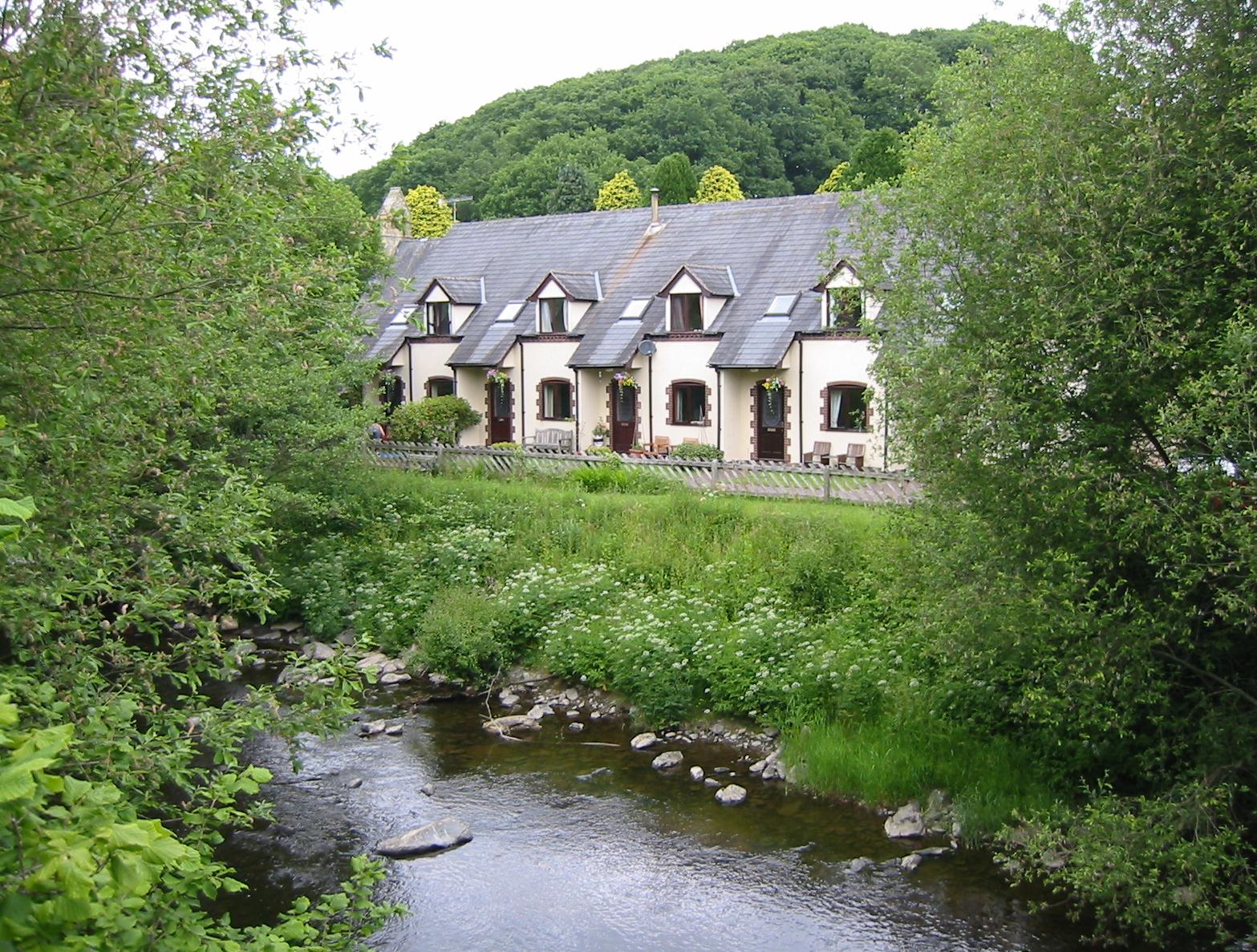
The Afon Vyrnwy at Pont Robert
One of the reasons why I had despaired over falling behind this morning was that I knew of the existence of a pub in the next village and, having played catch-up, there was now time to see if it was open. We still had a mile or so to go, walking on roadways among the farmsteads again, but shortly before 2:00 we pulled into Pont Robert. The party of nine were having a picnic in a grassy park here but (with just a few drops of moisture now evident) we rounded a corner in order to approach the Royal Oak pub. It was open.
A family was sitting out front and a little blonde girl in a long dress left off the compulsive ingestion of crisps to follow us into the very comfortable snug. I settled down on a low sofa to consume my pint while an ancient sheepdog brought me her squeaky toy. Tosh spent the next half hour interrogating the lady publican on the pub business in Pont Robert – a woeful tale of declining interest. Lots of people were choosing the place to retire but they didn’t come to the pub, it appeared. (Tosh spent the rest of the trip worrying about this situation and coming up with one naff solution after the next – “She should hire someone to teach knitting and have a sewing circle at the pub.”) We used the loos and at 2:30, my target time, we prepared to leave. We didn’t get very far because our first steps outside reminded us that it had really started to rain, and so we returned to the pub where it was much easier to put on our wet gear.
We now climbed our street, turning right at the Sion Chapel and continuing to the east on another road. This road twisted to the right as we reached Bryn-y-Fedwen farm but soon thereafter a stile invited us to resume our cross-country pursuits. (Stiles again lost to gates on this day, 19-7.) Hedges, fences and woodland served as our guideposts in gently rolling territory without steep ups and downs. I never spotted an old Quaker Meeting House on our right but we did locate an old green lane, a bridge, and, on our right, the farmstead of Coed-cowrhyd. The rain was light and not too irksome. Once, when I was changing pages, a drop of water plopped onto a page – but I was able to see through the speckles on my plastic map case without too much difficulty.
We reached tarmac, left it for more field walking, and reached tarmac again. When the lane veered to the right we climbed into a field ahead of us. I told the others that if skiers have the expression “off-piste” then this would be our last section “off-mac.” It lasted only a half-mile or so as we used a series of lanes to walk down the hillside of Gallt y Ancr on our right. I never spotted the sewage works on our left but, with the rain almost at an end now, we soon reached tarmac again, turning right for a speedy entrance into Meifod. At a well-manicured suburban corner we turned right to follow village streets past a school and into the heart of a sizeable town. It was only 4:30 – I believe we had covered thirteen miles on this day, our longest, but we were well ahead of schedule (we had told our landlady 6:00) because, in contrast to all the other days, we had encountered so little up and down.
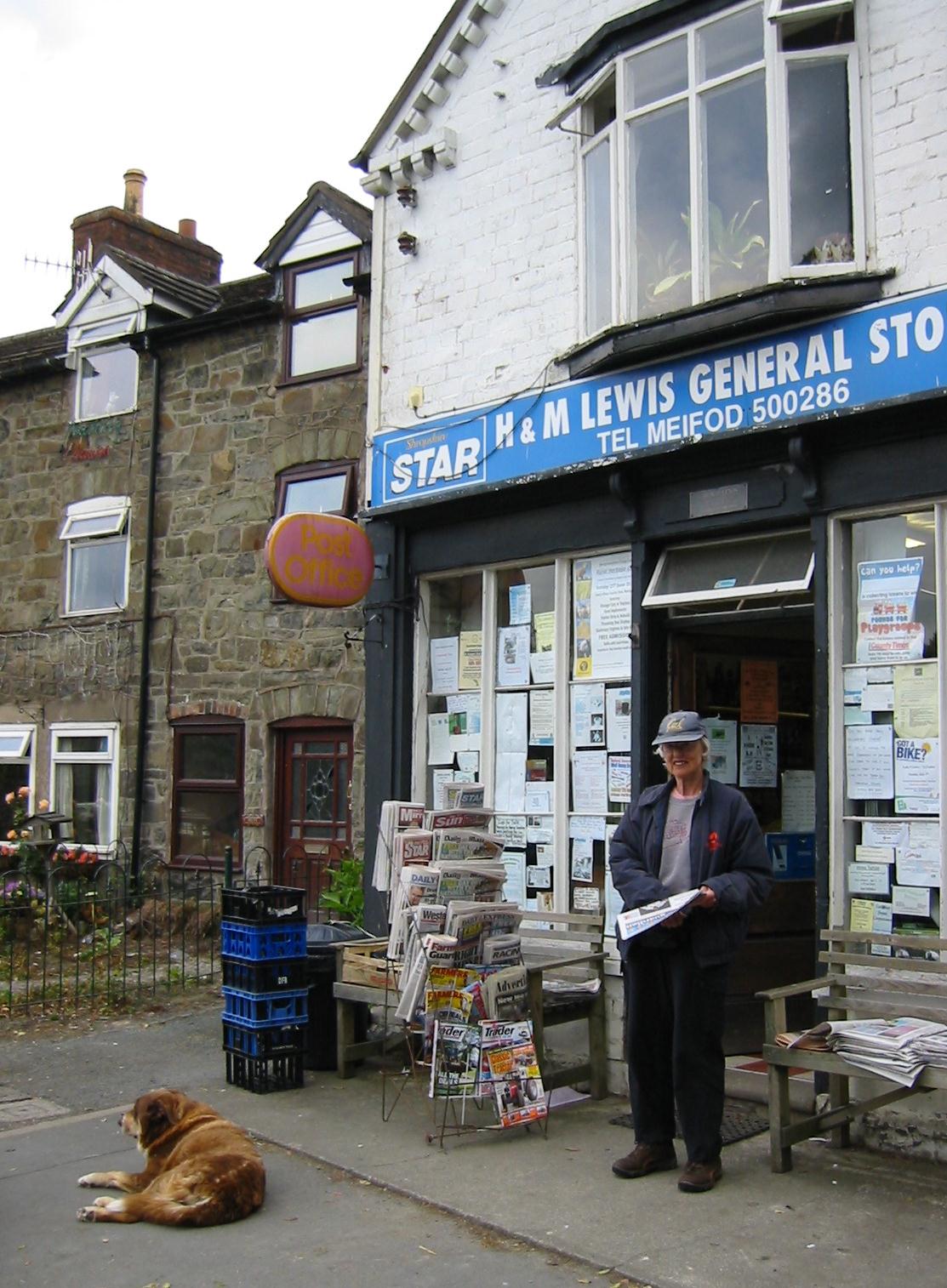
Tosh at the store in Meifod
At a crossroads we spotted a store and a pub on our left and while the girls penetrated the former I went to check out the latter, discovering in the snug of the King’s Head the last televised minutes of the World Cup match between the U.S.A. and Slovenia. (The Yanks trailed 2-1, then tied it up, then went ahead on a goal that was scandalously disallowed.) There was a lot on infant paraphernalia around as the publican’s wife had delivered a baby only six days earlier – there was also a red-haired thirteen month-old about as well. Here too Tosh engaged the publican in an extended dialogue, but this time the subject was politics and we heard a lot of sour recriminations on the crimes of the welfare state and the struggles of the businessman. More congenial were three tree surgeons who arrived after a few minutes. The boss of this outfit said that he had just finished a job at Clive Court in Maida Vale and that as a youth he had played football in Paddington Rec. After a while this trio went out back to smoke their hand-rolled tobacco and Tosh, Marge and I had a second round: double gin and tonics for me and Tosh, red wine for Marge.
Obviously we were having quite a relaxing time but at 5:30 we phoned Mrs. Breeze and announced our arrival. Her house, Tan y Graig, was only a mile up the road and so she arrived very quickly and loaded us aboard. Just north of Meifod she stopped for some farmers who were moving a herd of Holsteins across the road – yes, as many of the animals now demonstrated, cows can walk and shit at the same time. The farmer told Mrs. Breeze that beyond her house the road had been closed because of a fatal car crash – indeed we had seen one emergency vehicle speeding to the scene.
Tan y Graig was a very comfortable bungalow on two floors. Mrs. Breeze reported the safe arrival of Tosh’s coat as we sat in the vestibule to take off our boots (mine were still dry inside) and then we went upstairs to our bedrooms – only two this time, with Tosh and Marge required to share a twin. We all had nice showers and at 7:15 we entered the dining room for a lovely meal: salmon, hollandaise sauce, a variety of cooked vegetables, mashed potatoes. We had a small bottle of white wine (to go with all the alcohol we had consumed at the pub) and I finished the meal with a piece of lemon meringue pie.
Then we headed upstairs and entered my room to watch the World Cup match between England and Algeria, which had started at 7:30. We hadn’t missed much and, indeed, the match was a boring and dispiriting scoreless draw – leaving England’s further participation in the tournament up to the success of the team against Slovenia the following Wednesday. Margie was not much interested in this contest and she wearily took herself to bed across the hallway. Tosh soldiered on until the end, returning soon thereafter to reclaim her pillows, which she had left behind. I went to bed soon thereafter as well.
To continue with the next stage of our walk you need: