
June 16, 2008: Felindre To Llanbadarn Fynydd
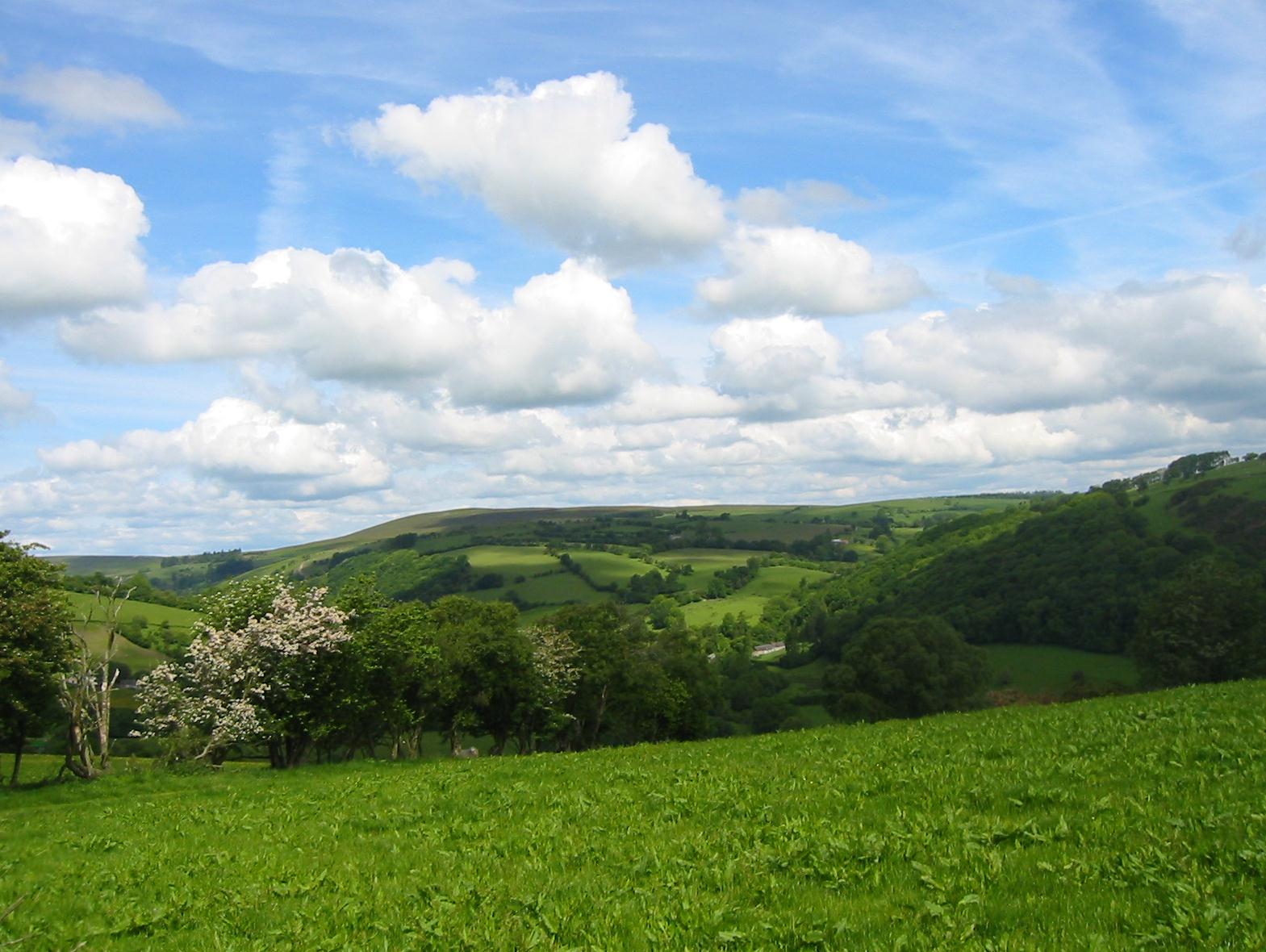
Looking north near Great Wood
It looked like we would have another fine morning as we rose for the third day of our expedition. We prepared our packs for the day’s transfer, again by Knighton Taxis, and then reported for breakfast at 8:30. There was a long discussion on the subject of egg poaching, which Mr. Brock was reluctant to attempt since, he said, eggs have to be just out of the hen for success. As he presented us with our packed lunches the topic shifted to wind turbines.
This topic seemed to be omnipresent in mid-Wales these days (indeed Westminster announced a new initiative the following week) and we had seen signs about protest meetings even on our drive between Ludlow and Knighton. Mr. Brock was definitively opposed to the intrusion of yet more masts in this lovely countryside, as, indeed, was everybody else we talked to on this topic during our trip – though, as in so many other instances, when “public consultation” was on offer, nobody had any confidence that the public would be listened to. Inefficient, noisy and ugly – only farmers who got £2,000 per installation seemed to be in favour of the idea. Only farmers and Tosh, who had bought into the alternative energy argument so profoundly that, on a walk a few months earlier, she had told me that she was resigning from the Ramblers Association because they had failed to embrace the scheme wholeheartedly. It was with some guilty pleasure that I could see her jaw drop as she finally realized that there were two sides to this debate after all. Meanwhile I used Mr. Brock’s phone to call our next landlady, Mrs. Ainsworth, regarding the time and place of our afternoon pickup. You couldn’t get a signal on a mobile phone hereabouts so there was no last minute improvisation in such matters.
We left at exactly 9:30 and dropped down to Felindre a second time, turning left at a crossroads and making a sharp right soon thereafter to enter a farmyard at Upper House Farm. At this farmstead there were a lot of barking dogs (many chained in barns, a sight I always hate to see) and they got quite a scolding from the resident farmer, who cheerfully warned us that we had three quarters of a mile worth of ascent ahead of us.
At the top of the long pull we began to encounter conifer plantations and these helped us measure our progress in a countryside of great charm. There were wonderful views all about us as we at last began a descent on tracks to the farm at Rhuvid. Here we excited the interest of more dogs, though these were loose and this made us feel quite uneasy and one brown specimen and one sheepdog literally dogged our heels until we had started to climb again on the west side of the farm.
As we neared the top of the next rise I could hear the dogs returning – but this time they were accompanied by a woman on horseback. The brown dog was missing but the sheepdog (Scott) and a young female (Josephine) were accompanying the rider. She explained that the dogs were not dangerous and that each belonged to a different member of her family. This group left the track and this allowed me to catch up with Margie and Tosh, who were having a little rest.
Here I pulled out my GPS unit and the OS map, convincing myself that, indeed, I would have been able to supply a precise reference for our whereabouts had anyone wanted to know – if had we gotten a signal on our mobile phone (there was a mast nearby but still no signal), and had I been the one doing all this, not Tosh or Margie. The GPS, incidentally, spoke in the language of longitude and latitude not grid references on the OS map. Such numbers do appear in the margin of such maps but you would certainly need the latter with you to do any serious orienteering.
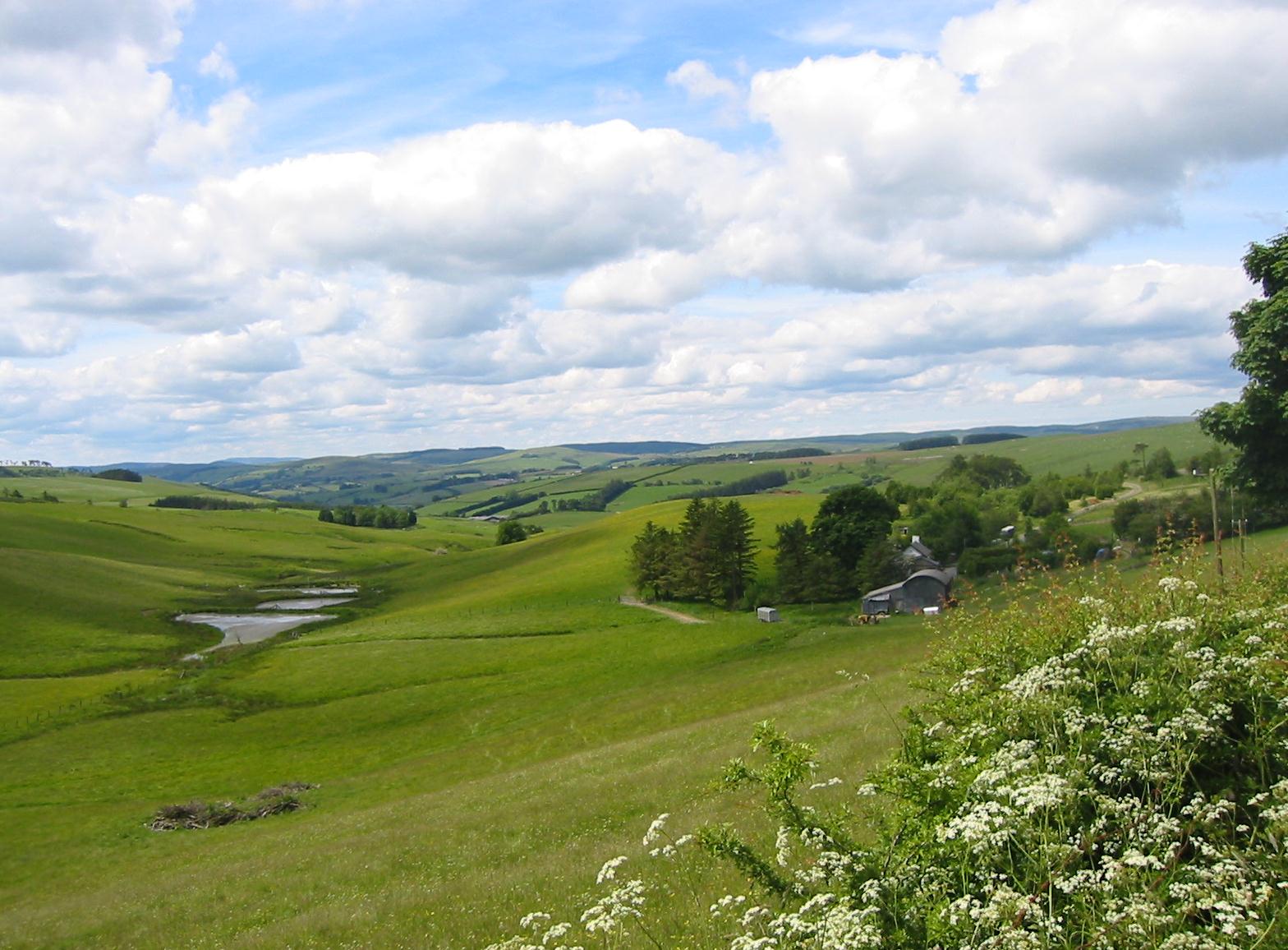
Ponds near Bryn Mawr cottage
We continued our westward trod, gradually descending to a track junction where we turned left and travelled overland in a southerly direction (with the help of stiles) as we began to climb a ridge. There was often no path about but the route was still well waymarked. Tosh was hunting for a place in which to have lunch and she found it at a spot where, on the opposite side of our bracken-clad valley, you could see a kind of dirt-track figure eight, something that made me wonder if motorcycles weren’t active hereabouts.
Mr. Brock had provided us with some drinking water in a plastic sleeve but my old Swiss Army knife was needed to help separate the cap from the rest of the assemblage. It was quite pleasant sitting in the grass but I needed the help of both women to rise from a seated position on my weakened legs.
Once upright again I continued forward slowly, climbing a stile into an old plantation where fallen trees often blocked the path – I preferred to find a way around these objects rather than squat beneath the horizontal trunks. There was some ambiguity as we cleared this spot, the guidebook asking us to “veer right over the brow of the hill” even though there was no path and no waymark in sight. We took this instruction on trust (I had my compass out as well) and eventually someone spotted a distant stile with an acorn, a dragon badge and an arrow, the common symbols encountered over and over again on Glyndwr’s Way.
We crossed a farm road and continued between two hills (one of which, on our right, carried the ruins of Castell-y-bladd). We were now climbing again, with waymarks leading us in a southwesterly direction up to a final stile onto a roadway. The route still demanded some uphill in very lonely countryside with only the occasional outbreak of trees, as at Fron Top. Finally we began our last descent of the day, a very long stretch on tarmac in the direction of the farmstead at Esgairwyndwn.
I warned Tosh that we would be looking for a stile in a hedgerow on our left soon after we had cleared this farm but she blithely walked past the spot and had to be called back. The route on the other side of the hedge headed downhill in parallel with the forsaken road – one of those typical route planning gestures designed to help walkers escape more road walking while providing rough uneven surfaces that are no match for the smooth progress to be made on tarmac. (There was virtually no traffic on this road either.)
Eventually we climbed a stile back onto the road, having, at 2:15, reached the village of Llanbadarn Fynydd. We had been told that the New Inn was newly closed but I still had hopes for the village shop, and so we turned right when we reached the highway and passed a petrol station where I spotted a shop in a kind of caravan. It would have to do as our oasis.
The shop lady pointed to the timbers of a building under construction next door. This would be the new village shop, community owned. Margie found her only mint choc cornetto of the trip in the freezer here, I found a cold Diet Coke, and Tosh went outside with a hot cup of coffee. I found a stool inside and sat down to sip my welcome drink. Since there would be no pub tonight Marge decided to buy a bottle of Scotch for our private use. Tosh tried to buy a toothbrush, convinced she had left hers behind in Felindre, but they had sold their toothbrush earlier that morning. There were a few newspapers for sale.
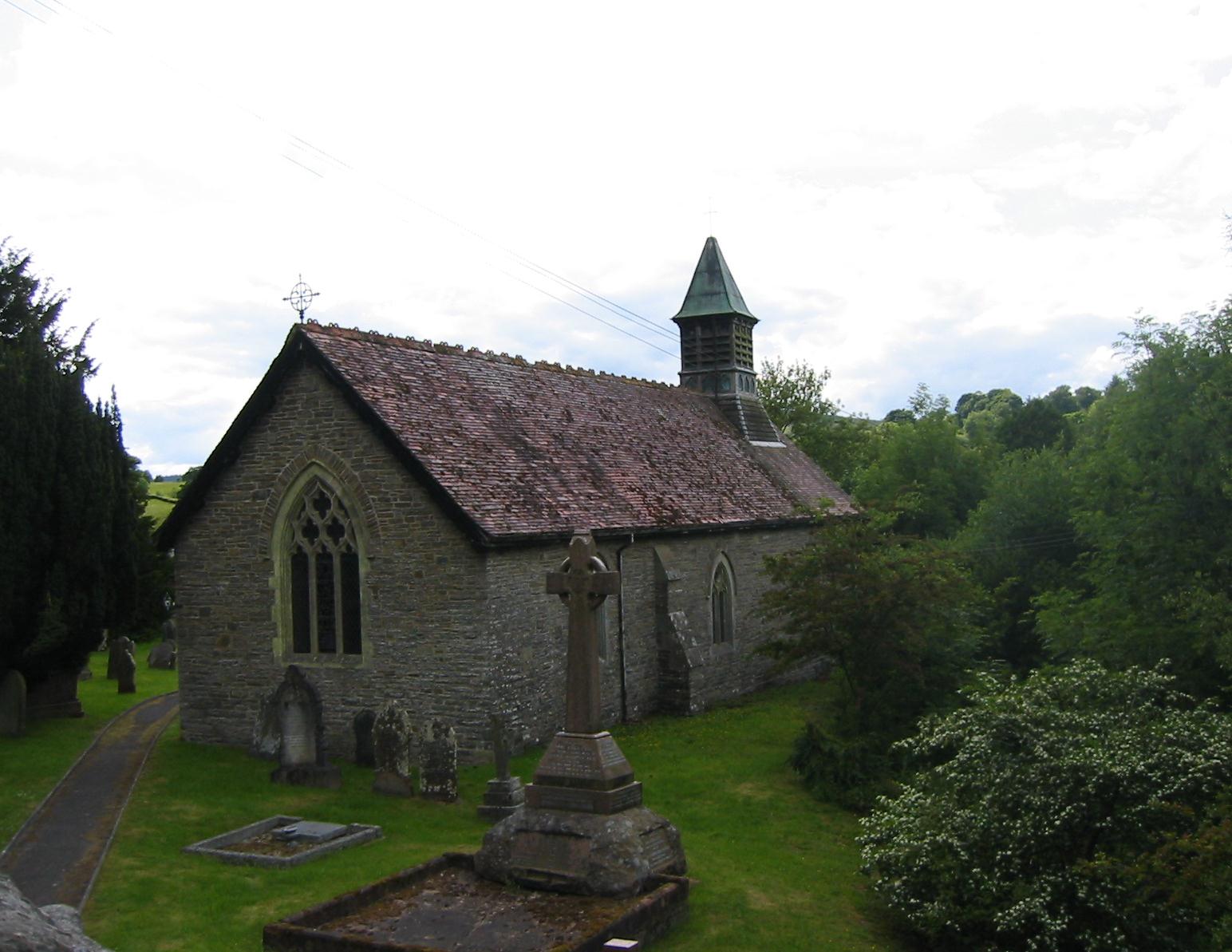
The church at Llanbadarn Fynydd
At about 2:40 I suggested we still had a quarter of a mile or so to go and so we headed south on the highway, with the Afon Ieithion, a trout stream, on our right. I knew that if we could reach a little church on the south side of the town that this would save some time on the morrow and so we headed here, turning off the highway with the GW and dropping down to a parking place in front of the church. It was 2:50 and we had walked eight miles. I had asked Mrs. Ainsworth to meet us here at 3:00 but she was slightly early and we were soon heading south in her car.
Her Hillside Guest Lodge was located on a little side road and in five minutes we were there and being shown to our rooms. Today would have been one of those dreaded nights when Tosh and Margie were supposed to share a room but Tosh, as was her habit, soon winkled out the information that there was an extra room in this establishment. It hadn’t been made up but, with Tosh agreeing to pay extra for it, Mrs. A. went downstairs to put sheets on the bed.
We each had showers, I had another go on my legs with the Deep Heat salve, and at 6:00 we met in Tosh’s room for drinks and crisps. I make it a rule never to have the TV on in my room on such trips but in the news junkie’s room I had to sit through the news and, worse, the weather – poorer conditions were heading our way on the next day.
At 7:00 we sat down to a meal of gammon steaks and pineapple while our host and hostess hovered and talked. (So often, it appears, rural life is a lonely enterprise and the chance to exchange conversation with houseguests a welcome diversion.) Mr. A. had three hobbies: metal detection, sentimental painting, and bonsai husbandry. The latter had been a money-making operation and there were still dozens of specimens in the elaborately tailored back gardens. We had a look around the place after dinner and I called my next landlady about a pickup spot for the next day. Then it was time for an early but well-earned rest.
To continue with the next stage of our walk you need: