
July 27, 1984: St. Bees to Sandwith

Fleswick Bay
With my walking stick and camera, our packs, and two shopping bags (not to mention young Bertie the Schnauzer) we were well encumbered as we climbed into the cab at 7:45 on Friday, July 27, 1984. Not surprisingly, I lost track of my brown Borsolino hat when we alighted at Euston Station. Nor could I find my cabbie when I returned hurriedly to the underground taxi rank after discovering of my loss – Bertie’s yelps of distress echoing through the station above me. Having arrived “too early,” according to the Mrs., we had plenty of time to take him outside in case there was anything to attend to on the grass, but he was now too excited by Dorothy’s desertion (in search of the loo and the morning paper). At about 8:15 we met Tosh and Harold at platform 4. Tosh was in a flap because she had lost her Visa card and she now wrote a frantic letter to Barclaycard while we sipped a last minute orange juice. Then it was down the platform in search of our reserved seats on the 8:35 to Preston. We were about to begin a major expedition in Lakeland, seven days of walking on Wainwright’s Coast-to-Coast Path.
The train journey was tedious. The others read and noshed, Bertie loose beneath our table. I stared out the window or intently at my watch – would we make our connection at Preston with all these delays along the line? Watford, Milton Keynes, Rugby, Crewe, Warrington, Wigan – we seemed to inch along. When we reached Preston we were already several minutes late; we dashed through the crowded station (not easy considering all our gear) and found a Lancaster train still waiting. It was a cranky little two-car job and we were facing the wrong direction. Still, I had noted that it had come from Whitehaven and, sure enough, it would head there as well after reaching Lancaster – thus we would not have to change again. I did insist that we move into the forward facing car and I also undertook an unsuccessful dash out onto the platform in Lancaster, hoping the fourteen month-old Bertie might anoint a pillar, but it was all too hasty for the little fellow – and the platform guard was glowering at us – so I jumped back and we were off on an endless Toonerville Trolley jaunt to St. Bees on the west coast of Cumbria.
We seemed to be the only tourists. The locals got on and off and gossiped about their teeth and their holidays. I noted that there were two conductors and a driver on this two-car shuttle. The countryside was fascinating, particularly Furness, which rose mysteriously out of the mist. After a while, though, an uninteresting coastal plane, ominously interrupted by the Sellafield nuclear site, replaced the hilly estuary country. I ate my packed lunch and we put on our boots. Bertie got a bowl of water. After six hours of train travel it was finally time to get off. In London there had been sun, Lancashire had been grey and Furness misty – but just as we reached St. Bees a light rain began. I hurried us up High House Road, following our landlady’s map, and thus we reached our b&b without getting too wet.
Our landlady showed us to our rooms and we deposited most of our gear here – for I had planned on some walking this afternoon. Now I carried only snacks and liquid in my pack, hidden beneath my new Alpine Sports rain cape. Naturally it took us longer than expected to make our getaway and it wasn’t until 3:25 that we were able to retrace our steps into town.
Here the girls divided, Dorothy heading for the market and Tosh disappearing into a post office. We crossed the railway tracks and missed a useful turnoff toward the beach, perhaps because Wainwright’s guidebook was only able to make casual appearances because of the wet. By the time I had seen my mistake it was necessary for us to walk back toward town again in order to follow a path behind the church. It emerged on the beach road where, surprisingly, two wet teenagers took us for locals and asked for information about the bus. In the lee of a little cabin I took a picture of the path heading up the cliff to the north, tried to tighten the lace on my left boot (an habitual and hopeless task), and attempted to figure out how to get onto the cliff without colliding with a caravan camp. “You look cross,” Dorothy remarked, “is anything the matter?” I grunted an unconvincing negative and we began our ascent of the steep and eroded path. After months of planning we were at last walking on the Coast-to-Coast route.

The St. Bees Lighthouse
The rain was very light and not unpleasant. The views were magnificent. A deep blue green sea rolled below us, bracken and heather and innumerable wild flowers blossomed at our feet. A freed Bertie charged up and down the trail in great excitement and bird watchers with binoculars scanned the skies. The girls stopped their minute dissection of the life and probable history of our recently-met landlady long enough to rave about the surroundings. These took on an even more dramatic cast as we approached Fleswick Bay. Here we decided not to descend to the rocks below, disdaining an eighteen-foot rock climb in such wet weather. Instead we detoured inland and found our way over to the other side on a poorly defined track; this improved when it was rejoined by the route from below. We rounded St. Bees Head, the westernmost point on this coast, and neared the lighthouse. Sheep had been excluded from many of the cliff tops but when we walked on the landward side of fences it was necessary to hook Bertie.
How slowly these initial miles seemed to go – we seemed to be crawling, and I started to question Wainwright’s measurements. At last we faced Saltom Bay, with its ships at sea and its factory smokestacks. It was difficult to know precisely where we were (on the map) and we had to hop several stiles and walls to keep to the path; the girls were trailing behind and reacted with resentment when I suggested that they might want to pick up the pace if they hoped to participate in a little diversion I had proposed – upon learning that dinner would not be served until 8:00.
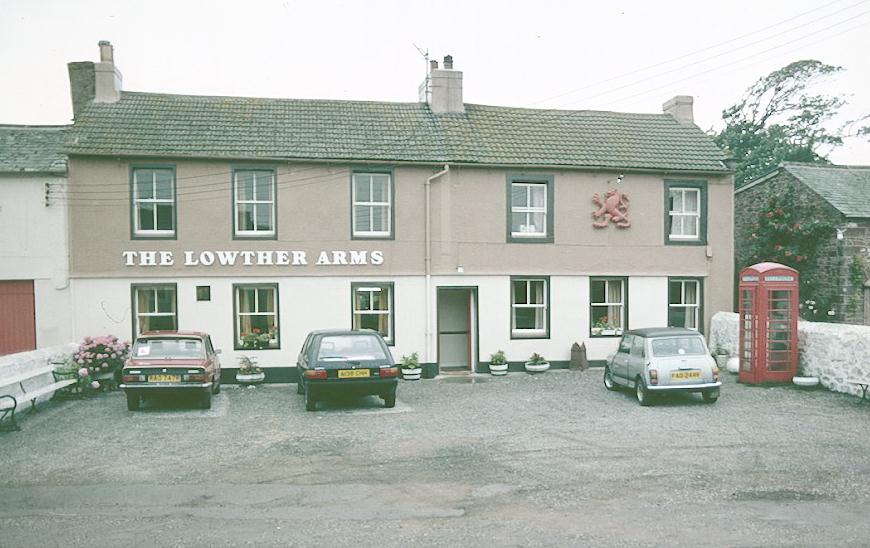
The Lowther Arms, Sandwith
We were walking down several lanes on the approach to Sandwith and I now proposed that we might have a brief stop at the Lowther Arms – before completing the last hour’s walk on tarmac back to St. Bees. Tosh proposed an even more brilliant variation – a taxicab ride back to our b&b. We entered the pub at a little past 6:00; it was completely empty but a shout raised a helpful lady publican – who not only served us whiskey and Matthew Brown Light Ale but researched the whole taxi matter for us, made our reservation and found a bottle so that she could sell the Lees eight measures of gin. We were thus able to extend our visit by an hour; I got down a pint and a half of Matty Brown, Bertie had his tea and we dried off a bit. The dog had the run of the pub – which remained almost empty.
Walkers who arrive in St. Bees in the afternoon can walk the first five miles, as we had done, and start from either Sandwith or St. Bees on day two the following morning – already having completed the circuit around St. Bees Head. You can also walk directly to Ennerdale Bridge on the Wainwright route in a single day, but you would need a morning departure to make the full fourteen and a half miles comfortably. Our cab now arrived at the pub at 7:15, and we thanked our hostess for all her help. We were back at our guesthouse in ten minutes.
Our host naturally made a disparaging remark when he saw us climb out of the estate wagon on our return – it looked like we had given up on our walking adventures already. We then returned to our rooms to clean up; poor Tosh and Harold were chagrined to discover that their room had no curtains and that it was unlikely that our ebullient hostess would have time to remedy this omission since all her efforts were concentrated on producing the evening meal – 8:00 stretched to 8:30 while we paced around in the sitting room; a youngster was called in to set the table and Tosh tried out the piano in the meantime.
The dinner was excellent – a bubbling Shepherd’s pie and veg. There were no other guests, just three members of the resident family and ourselves. Our host offered us a beer (which we declined); no one offered to say grace but both of these matters seemed somewhat out of character in a house where every square inch of wall space was covered with needlepoint samplers bearing pious religious injunctions. The church newsletters were also much in evidence and it was obvious that religion was dominant in our landlady’s world. She laughed a lot, hysterically, and seemed under a great strain – which Dorothy and Tosh were quick to diagnose as too much bed and breakfast. The latter diagnostician also argued for poverty as a source of discontent, encouraged by a thoughtful salute to Wainwright, whose choice of St. Bees as the starting point of the walk had sent to this establishment dozens of walkers – their postcards from Robin Hood’s Bay lined the front hallway. Bertie had the run of the house, even during dinner, and exited a few times through the kitchen door.
After pudding and coffee we returned to our rooms – still no one had produced anything for the Lees to cover their window with but, of course, there was no sunset. It had been a tiring day. Outside the resident owl hooted its evensong. Bertie needed a last perambulation so we all decided to walk into town. I mailed the first of eight postcards to Jay, my Pennine Way walking companion, and we fought our way into the crowded lounge bar of the Queen’s Hotel. Much fuss was made of a slightly damp Schnauzer. It was black as we edged our way back to our beds at 10:00.
To continue with our next stage you need: