
June 28, 1999: Reeth to Richmond
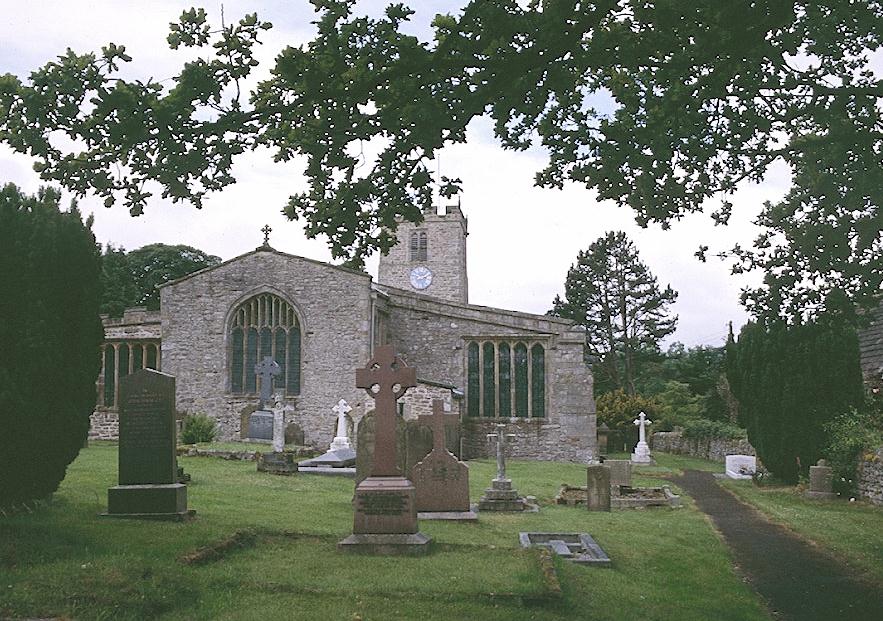
Grinton Church
We ate breakfast in the Buck Hotel’s upstairs dining room on a cloudy day, one that couldn’t make up its mind whether to rain or shine. We brought our bags down for the Sherpa people but Tosh went off in search of a newspaper, wandering around aimlessly (instead of heading straight for the post office as I suggested) and in her absence I had a chance to step outside several times to sample the weather. People were carrying umbrellas against a light drizzle and Harold and I decided to put on our rain gear. It was fairly chilly outside as well, though visibility was great; the moisture had ceased, and there were bright patches in the skies as well.
We were off at 9:50, bisecting the green on the main road, which took us up to a bridge over the Arkle Beck. The sun came out as we left the road for a field path heading for the Swale and when we reached the river we abandoned the C-to-C path briefly for a look at Grinton village. The Lees spent some time in the church (“the cathedral of the Dales”) while I took pictures. Then it was back over Grinton Bridge to find a path on the north side of the river as it swept majestically eastward. This was great walking, although I was slowed by the stiles, but at the end the path climbed up to the tarmac road to Merrick Priory, whose medieval tower we could see almost a mile before we reached this establishment itself. The way forward was very flat for once and there was not too much traffic (the postie passed us twice) and before long we were opposite the priory itself; built for Benedictine nuns in the 12th Century, the place was now a youth activity center and cars with canoe racks were parked out in front.
Our route left the tarmac here to climb up through Steps Wood on a wonderful path made of flagstones, the “Nun’s Causeway.” It would be very boring if all woodland transits, which are often very muddy, were accomplished on such surfaces, but I must say that the steep gradient seemed very much more humane under such circumstances. The only problem was that the raindrops had returned.
At the top we reached a road into the village of Merrick. Tosh had been fantasizing about a tearoom, but we saw no evidence of any amenities. There was a poster for “Elaine’s,” a b&b establishment at Nun Cote Nook Farm, one that also offered refreshments, and I promised Tosh that this would not be far off-path. Our route required us to round a corner past the former schoolhouse and take a series of overgrown field paths along the eastern edge of the village. Tosh refused to believe that such a desperate crossing was needed and ended up on the wrong side of a stone wall in her stubbornness. The last of the field crossings was a very mucky barnyard in which delightful new calves were dozing next to their moms. Fortunately we could escape the manure by climbing a final stile and descending through a meadow to a farm track. This lead to Nun Cote Nook Farm and we decided to pay it a visit. Just as we neared the back garden a shower lashed at our faces from the west; I tried to find some shelter for my camera, which I was still wearing on the outside of my rain jacket and gratefully I passed through the beaded curtain into Elaine Stones’ kitchen.
The Lees had tea and toasted teacakes while I just drank a Fanta orange. The kitchen was decorated with the prizes won by Elaine for her white-faced sheep. There were two toddlers about, one at school, and Elaine – who seemed to have a fascination with breeding, said she wanted one more. Mr. Stones came in as well and the Lees quizzed him about life in the sheep trade. He said that the wool was now virtually worthless, though the sheep still had to be shorn, and that his beasts were raised only for meat. Tosh gave a long speech about her preference for British lamb and this certainly did cheer up the farmer. “I say,” he concluded, “the only thing better than a piece of meat on my plate is another piece of meat.”
The weather had improved somewhat when it was time for us to leave and we were soon back at the junction of the farm track and the descending path we had used before. Down this route there now came a large party of walkers, a parade, and I suggested we let them get ahead of us. They were greeted as they reached the bottom of the hill by their leader – whom I recognized! “Hugh,” I said, reaching out a hand. It was Hugh Dyer-Westacott, professional walk leader and husband of ASL’s head librarian, Joan. I had spent many hours over the years comparing walking notes with him (and had even used his long outdated guide to the Ridgeway Path in 1981) but we had never crossed paths before and I had no idea he would be doing a two week excursion for Americans on the Coast-to-Coast Path. He was delighted to see me here as well and introduced me, Tosh (whom he knew as well) and Harold to his party.
We walked with him for about a mile and we had a good chat as we crossed a series of fields. Hugh said he wanted to buy Ellers, an abandoned farmhouse, for his retirement years – since it didn’t even have access by road, but somehow I couldn’t see Joan or the kids enjoying this idyll for long. I started to fall behind a bit as we headed uphill to Hollins Farm. Meanwhile Harold was deep in conversation with some people from Berkeley (he was wearing his Cal cap) and enjoying the interlude very much. Tosh wanted to stay behind for some privacy so we said goodbye to the group at Hollins Farm, even though Hugh had promised to show us a way into Marske village that avoided road walking (he has a greater antipathy for such forms of progress than I do).
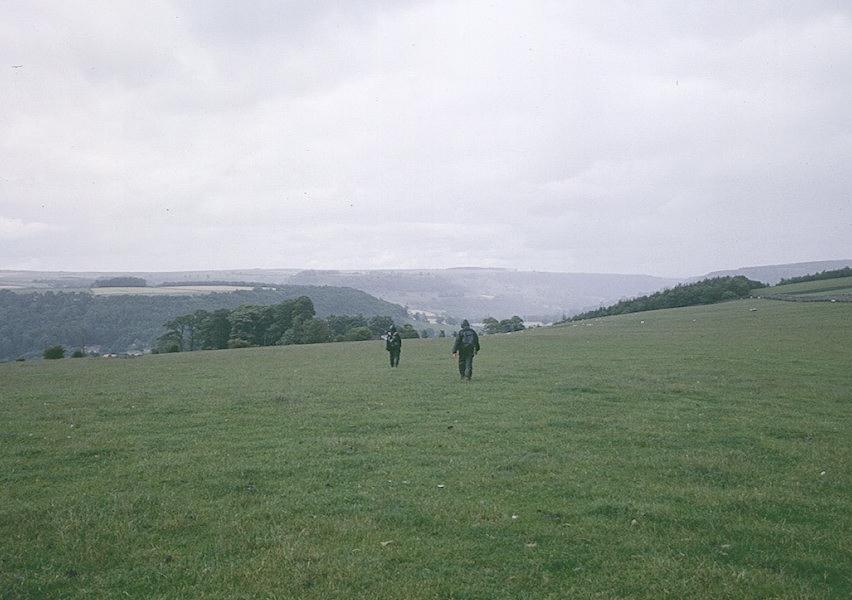
We descend to the Marske Road.
When we started up again I noticed that Hugh had lead his charges due north against a wall, one which the guidebook tells the rest of us to cross; and so we did. This was a moment when you needed a little courage to believe what you are reading since there was no evidence of path here – only the injunction to cross the brow of the hill. This I ordered Tosh to do and we were rewarded by the sight of a stile in a field corner far below us. Crossing it put us on the road to Marske, which we descended steeply to a village crossroads. I was hoping to find some place for us to have our lunch and was lucky to spot a stone shelter with a bench across the street. It had been built in honor of a recent owner of Marske Hall and it proved to be so much better a spot for a meal than the abutment of Level House Bridge the day before. We tucked into our Buck’s Hotel packed lunches, including the last of my 3000-mile cake, and, by the time we were ready to move on, the sun had come out and we were through with rain for the day.
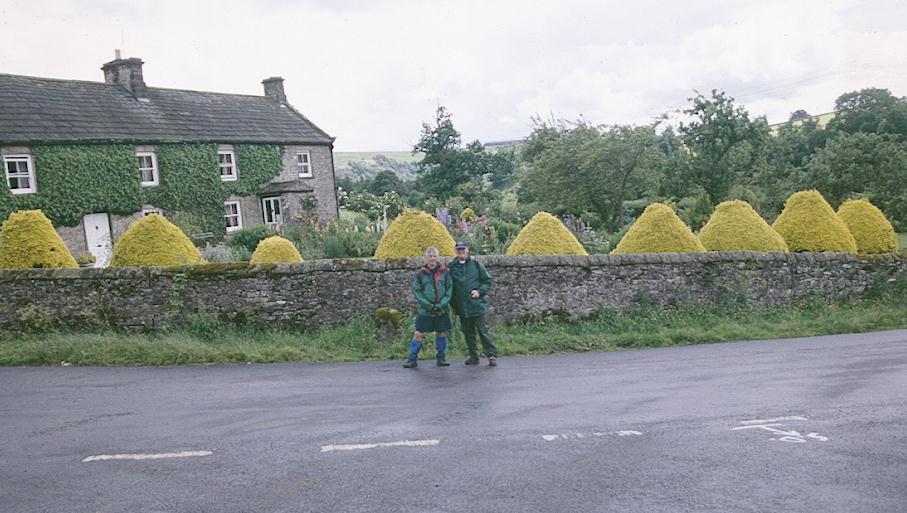
I pose with Hugh Dyer-Westacott in Marske.
At the top of the village we encountered Hugh and his troops again and I had Tosh take a picture of the two of us against the backdrop of a wonderful flower-bedecked cottage. Harold has more conversation with the group from Cal; he said they were about to begin singing school songs. “Only if I can sing ‘Hail to the Hills of Westwood’ too,” I added. We still had the group in our sights as we continued on tarmac in a northeasterly direction and then took to the fields for a series of stile hopping ventures as we descended to Clapgate Beck. It was a very steep and muddy last hundred yards down to this stream and I took a wide left turn around the worst of it. Ahead of us we now had a wonderful view of the rocky outcrops of Applegarth Scar shining through its trees. There was a steep climb to a farm road beneath the scar and here we had a nice rest and some liquid. The views back down to the valley were magnificent: except for the orderly hedgerows one could almost believe that man had taken no hand in the making of such a beautiful landscape.
Our way now lead eastward past a series of farmyards, West Applegarth, Low Applegarth, East Applegarth (a converted barn had been named High Applegarth). Route finding was not too difficult though there were gaps between these places requiring some choice of meadow crossing routes and stiles. Whitecliff Scar was now on our left and soon we entered an undulating track through Whitecliff Wood – which seemed to be dark and humid after all the brilliant sunshine. At High Leases we encountered tarmac again and continued forward, gradually losing elevation, with distant views of Richmond itself to cheer us on.
As we entered the suburban streets of the famous market town the Lees were slowed by all the front yard gardens; lots of people were out exercising their dogs as well. At the bottom we turned right against the traffic and, while we were puzzling over the map, a chap in a car asked us where we wanted to go, and then gave us directions to the market square. Harold spotted the back entrance to our hotel, The King’s Head, before we had quite reached the square and so we were ushered into our poshest accommodation of the trip through the car park. It was 4:50 and we had walked 11 miles. Our packs were arrived and we were soon slipping into our baths. My marbleized bathroom was even grander than my rather pokey single room (though the hot water tap kept falling off).
I had a nice rest and at 6:30 I swept up the Lees and we went down to the bar, where I had a nice pint. We had made a reservation in the dining room for 7:30, but this was a mistake. The Lees, naturally, had the rack of lamb – and this looked good but my starter, lumpy stuffed doughballs of a vaguely Italianate flavor, were cold – and the chicken breast came with the skin still attached, half of the flesh dyed pink, and all this in a nest of half cooked noodles floating in a yellow green sauce with two crossed asparagus tips. I cut my meat into pieces and ate the vegetables. Harold ordered a bottle of California red and this was the best part of the meal. A little culinary knowledge is a dangerous thing for these Northern chefs, I would say.
After dinner we had a stroll about the market square, checked out some bus times, and ran into Ian making a telephone call. We crowded into a bar to bid farewell to him and Monique and then returned to our hotel. The Lees and I had both visited Richmond several times (though this was the first time I had arrived without my tail between my legs) and so there was not much interest in further sightseeing. So it was another early night after another eventful day of walking.
To continue with our next stage you need: