
July 28, 1984: St. Bees to Ennerdale Bridge
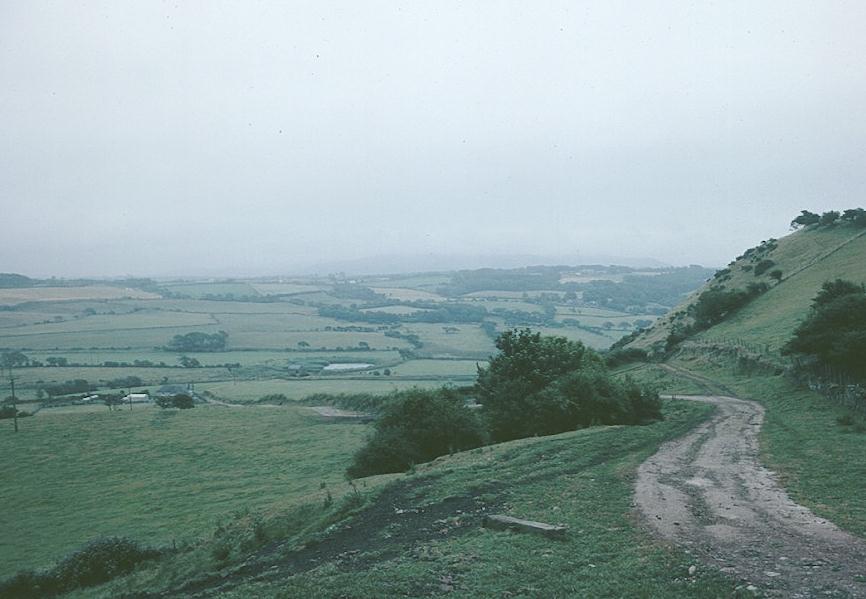
The view from Bell House
There was no sunrise. We had asked for breakfast at 8:30, but it was soon obvious that our struggling landlady wasn’t going to come near this target (and make packed lunches as well). So I took Bertie out for a little walk in the mist and we sat down around 8:50. The food was again excellent, but I was getting anxious to be off. I never succeeded in getting a truly early start on this trip, though this was not the fault of my troops –who were very cooperative about being ready for an 8:30 breakfast bell. We were now asked to send a postcard, but as we weren’t planning to reach Robin Hood’s Bay anyway, we forgot.
The others had not felt the full burden of their packs before this and it came as something of a shock, particularly to Dorothy. We got only as far as the nearest market before the girls had peeled off for some late purchases. Then it was past the church for the last time and up the steep hill down which our taxi had descended the previous evening. Rain became steady as we reached the higher elevations and it was a bore reeling in the dog as cars neared. Bertie’s extendo-lead, fastened to my belt above my right rear pocket, could be played out through the right armhole of my rain cape. The dog frequently ran around behind me, however, and this required a cumbersome pirouette on my part to straighten out the line. When he was not doing this, or tangling his feet in the cord, he was jerking violently ahead and wrenching my back. All these annoyances –and still we were happy to have the lead with us, for it proved its utility many times. While I was maneuvering the dog up the tarmac on our slow return trip to Sandwith the girls kept up their chatter about our landlady: the woman was going to snap any day now, the rest of her family wasn’t pulling their weight, the husband never finished a box of cereal and she never got around to throwing out the nearly empty cartons – no wonder she was loop-de-loop about religion.
After a rain-soaked hour we reached Sandwith, with the Lowther Arms off to our left, and turned off onto a farm lane, able at last to unyoke the dog – back on the Coast-to-Coast Path once more. I kept trying to take pictures when the moisture dwindled, never knowing when I would get my last chance on a very misty day. We passed Demesne Farm, turned south on a farm track, crossed the B5345, and reached a wall opposite Bell House Farm. Here we encountered a handsome and aristocratic couple (father and daughter) in shorts. They were doing the route east to west and were in the last stages of a twelve-day odyssey. We offered them our congratulations and had a brief rest at a viewpoint that included a lake to the north and little Stanley Pond, on our route, to the east.
I took off my rain cape at this point, for the drizzle had come to an end. When we descended to the rail line and crossed it to reach the pond routefinding began to be a bit more mysterious. The written description appeared to make sense on the ground; we seemed to find appropriate fences, gates and tracks, but when we emerged from the woods the road facing us did not correspond at all with Wainwright’s map. I left the others and ascended to a busy corner, soon ascertaining that we had emerged too far to the south – on one of the roads to St. Bees – having failed to make the northerly progress needed in order to emerge opposite Scalegill Road. I returned down the hill, trying vainly to whistle up my chattering companions. We then marched up to the A595 and followed it to our turnoff to Moor Row. When we reached the outskirts of this village we found a deserted kiddy playground. The view ahead, with Dent lost in mist, was not encouraging – so we decided to have a go at lunch before the rain began again.
We sat on a wet park bench. I still had one of yesterday’s sandwiches to finish and this was to be preferred to our landlady’s dry frozen baps or the assortment of chipped wood pulp and dehydrated coconut shavings (including the shell?) that she had concentrated in little cellophane sacks. There was even a granola bar. Bertie, who was often the beneficiary of our disdain, was free to run at will in the playground, but he disgraced himself by running into the street to protest at the arrival of a horse. Dorothy ran after him disapprovingly, but I did not suppose this would in any way prevent similar hysteria the next time he heard clip-clops. Dorothy and I shared a can of beer and when it was finished we packed up. There was no rain, but it was still grey and cold and I wanted to keep moving. Dent was no clearer.

From Moor Row to Cleator
A Nissan car showroom in Moor Row seemed astonishingly out of place. A Town Like Alice and Tenko were still making their TV appearances and here, in rural Cumbria, was this far outpost of Japanese enterprise! We turned south and found a stile into a field. Here I did some reconnoitering – even using my compass – while the others added some tape to sore feet. We then followed a series of field paths to Cleator and here, at a little past 2:00, we decided to have a brief stop in the Three Tuns. A group of walkers was just leaving as we arrived; they faced a hazard we were only temporarily escaping – the return of the rain. In a corner of the pub we slipped off our packs. Halves of Matty Brown were ordered. We were about to enjoy a moment’s relaxation when another American couple marched in. He was a talkative blowhard in shorts, bragging over his many triumphs in completing Wainwright’s route backwards. His girlfriend, who had joined him only in Grasmere, wasn’t allowed to speak, but he claimed she was carrying a 30-pound pack and that his weighed 38. As they were staying in bed and breakfast accommodation one was tempted to ask why? – but there wasn’t much chance to interrupt the monologue. I particularly dislike trail lore narratives of this type because they only create anxiety by exaggerating the difficulties to come. Harold took an instant dislike to the chap and the girls decided he had to be a Marin County trendy. What the lad behind the bar must have thought of this convention of Yanks in his parents’ pub is hard to imagine. I had never encountered another American in three weeks on the Pennine Way.
We didn’t stay long in the Three Tuns, though we had to brave the rain again when we re-emerged. Over the Ehen we went, using the Blackhow Bridge. On the other side a huge jogger in a red t-shirt rushed down our track, training for the rugby season no doubt. Small changes in the route meant that I had to do some scouting to see how to get us around Black How Farm, with Bertie racing back to show the others where I had gone. I emerged onto the Ennerdale Bridge-Egremont road, with the access to the Dent track clearly marked on a wooden gate opposite – “C to C.” This, and a few other inscriptions on the gates and posts of this hill, were the only specific references on the ground to Wainwright’s route encountered on this entire trip. (Our venture was long before the route became an efficiently marked trail.) I wanted to take a picture here, but the rain was just too strong.
So we began our ascent, climbing a thousand feet with very little difficulty, if you discount a few route-finding anxieties – mostly occasioned by the extremely poor visibility. Of course we had a fence to follow, but I had to be sure we were on the right hill – an inviting path to Flat Fell near the bottom had to be rejected with the aid of my compass. Then our route did not always take the side of the fence specified in Wainwright’s drawings. Also it was hard to see which was the highest point on Dent. A huge cairn near the summit was obviously not on the highest ground. We had one rest in the rain, consumed some spirits against the damp, and pressed on.
Almost before knowing it we were on the descent. I continued to use my compass: we had reached the forestry plantation and its gap without any warning – that’s how poor the visibility was. I made a number of decisions on instinct here. Fortunately we found the continuation of the ridge top path beneath the plantation. I rejected a number of inviting tracks that crossed our line of descent, wishing to avoid the cliffs of Raven’s Crag. Dorothy, suffering from vertigo, held onto my rain cape and followed my footsteps whenever we attempted steep descents on this trip. Tosh was often ahead, but when she led like this she was also required to keep the dog’s lead. Bertie’s eagerness to be first meant that an intolerable strain was placed on anyone attempting to lead him from a position further back in our single file – he would tug so. The dog looked like a drowned rat by this time; his stomach was caked with mud.
Just before we descended into Nannycatch the mist cleared enough to give us some wonderful Lakeland views of this Arcadian ravine. Things were a bit brighter as we walked along the beck, but there was still no shelter from the rain. We were getting tired and it was hard to find the appropriate exit from the valley. The path I followed put us out on the access track to Low Cock How Farm, only a few yards off the Calder Bridge-Ennerdale Bridge road.
While I was puzzling this out a car emerged from the farm and its driver pointed Tosh in the right direction. “Why are there so many sheep skeletons?” the latter wanted to know, and, “How soon are we going to be at our hotel?” This question was asked with repeated urgency as we neared our village but, of course, I couldn’t be pinned down precisely and besides, there was now a new problem: two goats, charmed by the chained Bertie, were following us down the road. We had enough trouble with traffic as it was, and there was suddenly a lot of it about. Harold and I made several charges at the goats but this only put them off momentarily. We didn’t look back for several hundred yards, but when we did, they were gone at last.
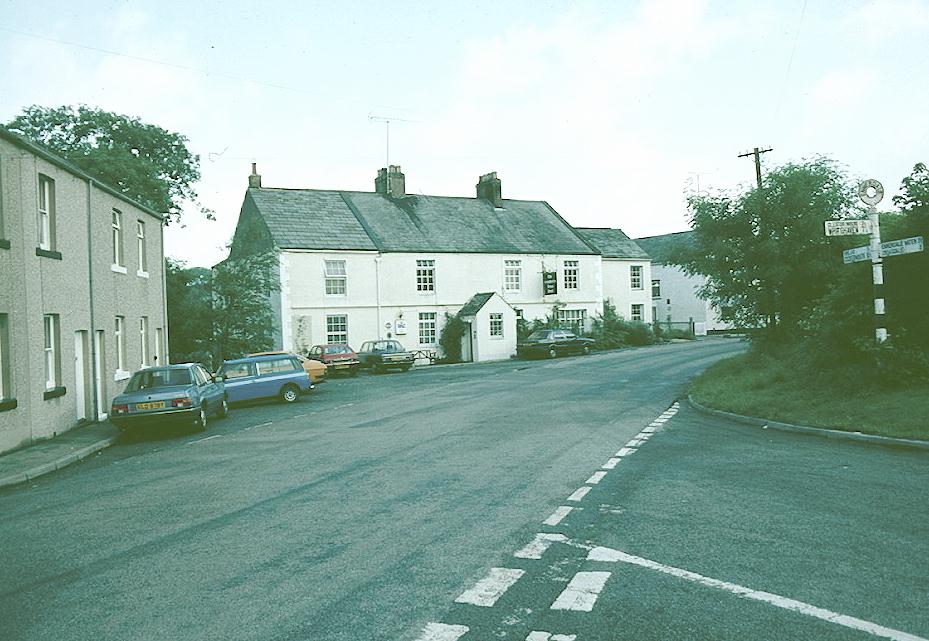
The Shepherd’s Arms, Ennerdale Bridge
After eleven and a half miles we entered Ennerdale Bridge and crossed the Ehen again at 4:30. The Shepherd’s Arms Hotel was a most welcome sight. We were asked by Mr. Whitfield Butt, our landlord, to remove our boots before entering. He did not seem particularly sanguine about the possibilities of returning them to us in a dry state – but he took them and some of Harold’s waterproofs while we struggled upstairs with our packs.
Tosh was rushing through the hotel trying to find a loo. In fact loos and showers were en suite and the first order of the day was to get the dog into the latter. I stripped off my damp clothes and pulled Bertie in behind me. There hadn’t been time to find the puppy shampoo, so I used our Henara on the dog’s tummy. Dorothy then came in and toweled him off while I completed my ablutions. Dorothy then took our place while I laid out various items of clothing to dry. I even tried to wrap the wet extendo-lead around the feet of furniture but Dorothy repeatedly tripped over the cord (with expletives included) so I gave up on this.
At 6:30 we joined Tosh and Harold in the lounge bar. We were still accompanied by a now dry Schnauzer, but Mr. Butt reminded me that the dog, of course, would not be allowed into the dining room. This meant that the awful moment had come – true separation. I led him up to our room and shut the door quickly behind me. I tiptoed down the stairs, prepared to hear cries of outrage, but there was only one half-hearted whimper. The dog was obviously only too glad to go to sleep at this point. We never again had any problem with leaving him in our room when the time came for us to go down to dinner.
Our meal was excellent. I had lamb chops and the others salmon. The rain continued to fall, drops collecting in the top of a bush near our window and filtering down the stem to lower leaves. After the ice cream and the tipsy cake we sat in the lounge for coffee. The dining room had been quite full and we now chatted with the other hotel guests, most of whom were taking short walks with the assistance of their cars. It seemed impossible to have a conversation about Lakeland topography without evoking the name of Wainwright.
When it was dark I fetched Bertie, who sat for a while on one of the lounge divans and was fussed over by the guests. Then I had to put on my rain gear and take him for a last walk around the nearby school. We were in bed by 10:30
To continue with our next stage you need: