
November 5, 1981: Watlington to Princes Risborough
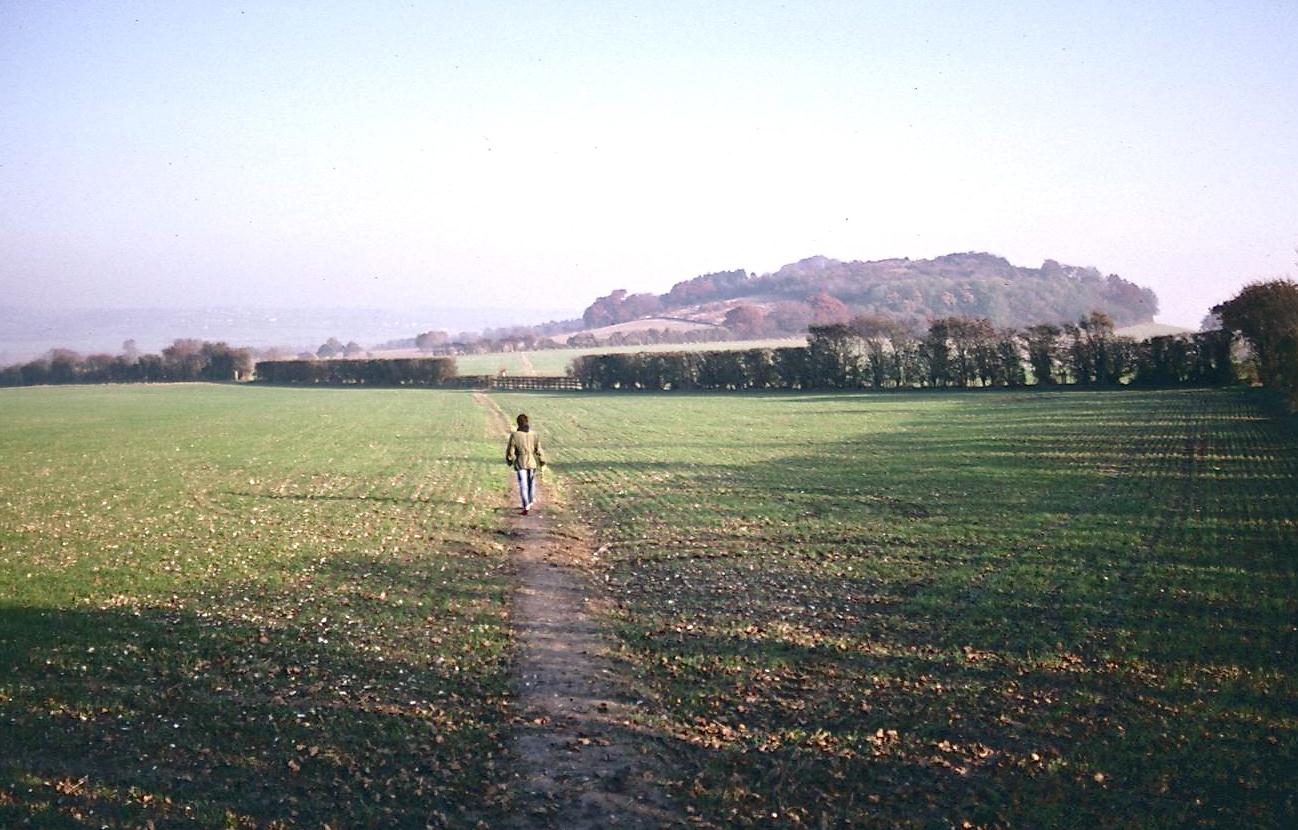
Tony approaching Lodge Hill
Tony Babarik, who had joined me on my third day on the South Downs Way, made a comeback as my walking companion on the sixth day of my attempt to complete the Ridgeway. He appeared at Paddington in his red Adidas and my old UCLA zipper sweater precisely at 7:30. We bought coffee and boarded the 7:45 train to Reading. During this stage of the journey I filled him in on a tragic event in the lives of all British soap opera watchers – the fire that had last night destroyed Crossroads Motel. The papers were full of the hysterics of anguished Meg Mortimer fans.
It was foggy, as predicted, in the Thames Valley – and most of the journey to Oxford was made in mist. Here I discovered that the return ticket I was traveling on (one I had shown to one guard at Paddington and to a conductor aboard the Reading train) was not valid after all. I was incensed and made quite a fuss at Oxford station before paying up. Tony and I walked over to the Gloucester Green bus station – Tony musing over the idea of setting up a second sheet shop here. Indeed, the subject of bed linen naturally recurred a number of times during the day. We passed a Chinese restaurant called The Opium Den. “And they wouldn’t let me call our shop ‘Wet Dreams,’” Tony complained.
Before boarding the 9:40 bus to Watlington I found a lucky penny. The ride was not particularly interesting. Once again the route passed BL’s Cowley plant – whose workers had just gone grudgingly back to work after a strike. Tony was charmed by the little stream running through the front yards in Chalgrove, as I had been. Soon we were in Watlington. The fog, which had lifted once in Oxford, had returned and the idea of having it around all day was disturbing. We quickly made our way out of town by road – with fewer cars to dodge than last time. This was just as well, considering the poor visibility. “How will I know if it’s fog or just my dirty contact lenses?” Tony asked. When we reached Icknield I took my camera out. Fortunately the sun soon broke through. We had blue sky and golden, though hazy light for the rest of the day. It was a bit warmer than last time and I was able to take my coat off within a mile. Tony retained his throughout the day.
The route was easy to follow, straightforward and unvarying for miles, a level slog in a northeasterly direction over muddy lanes embowered in autumn foliage. Much of it was quite lovely and Tony, in spite of his wet Adidas, managed to retain his good spirits. We were both taken by the marvelous orange of the beech tree leaves underfoot. Tony picked a few plants and the last of the blackberries – which Howard had started to harvest so long ago. Once again there was not another genuine Ridgeway walker to be seen during the entire course of the day. We passed no towns and rarely approached civilization. One of these latter occasions came when we walked beneath the M40 at the four-mile mark. We were discussing religion at this point, Tony having recently been disturbed by the madness of born-again Christianity. However we soon returned to more popular topics, i.e., who would play Tony Babarik in the movie version of the Bunny Dexter story. “I want to be played by Bette Midler,” Tony insisted. “And who would play Bunny herself?” I asked. “Divine,” he replied.
We were soon walking on the ridge between two halves of the Chinnor cement quarries. Here we passed a worker in a hard hat – whom we had mistaken for a real walker. He nevertheless commented on the niceness of the day. At the end of the green road we encountered a woman who asked us for help in rescuing her dog. It seems that Sheba had squeezed beneath the chain link fence and couldn’t figure out how to get back out. We had just about concluded that one of us would have to climb the fence and hand the brown mutt back over the top (and I was going to nominate Tony since he might get a better grip on the fence in his Adidas than I would in my clunkers) when Sheba got it all figured out herself and re-emerged on our side of the fence.
Shortly after Steppinghill, at the seven and a half mile mark, we left the leafy path to a solitary and muddied jogger and climbed up an embankment to find a sunny spot in some almost dry grass, where, amid sawdust and rabbit droppings, I prepared lunch. It was the usual, much appreciated spread, supplemented by a couple of cans of Carlsberg which I had been lugging in my pack. It was great to feel some warmth from the November sun.
The section of the route near Hempton Wainhill was quite lovely. We passed through a private garden and along a forested road that was clogged with a huge tractor and trailer, into which logs were being loaded. One of the workers was shouting down the hill to his mate, “Henry says it’s the treat of a lifetime to watch you trying to back up the rig.” “Tell Henry it’s his turn next,” came the surly reply.
After we left the forest there was a tricky turnoff into a field, located by the presence of a stile with an acorn on it. A path had been worn in the grass, which enabled us to make a rapid descent of the field, but at the bottom we overshot a second stile by a few yards before finding it and descending to the Bledlow road.
A cornfield had to be crossed to reach wooded Lodge Hill, our only “summit” of the day. I observed to Tony that the farmer was a good guy because he hadn’t ploughed up the path across his property and it was easy to follow it to the foot of the hill. A short steep sprint brought us to the grassy top of Lodge Hill, a delightful eminence. For some reason a concrete Ridgeway plinth appeared every 50 yards on this stretch but no sooner had we begun the eastern descent then we ran out of waymarks altogether. We were misled by arrows pointing down the hill to Saunderton – and after we had descended a hundred yards toward an electricity pylon I argued that we must have missed a turnoff. So we went back to the top of the field and changed our angle of descent. Horse prints showed we were on a well-traveled right of way and at a road crossing there was a green and white Ridgeway sign. Tony claimed that all of this was the guidebook’s fault for describing a critical landmark, a two story square brick modern home, as a “cottage.”
We walked around the yard of said domicile and through some fields toward the first of two rail crossings. In the late afternoon sun we could see dew in a thousand cobwebs suspended above the grass. We climbed a small hill and met up with the first of several roads that took us toward Princes Risborough. The first was empty of cars and the second, the A4020, had a sidewalk. We were both growing tired and footsore as we made our last official turnoff, onto the Upper Icknield Way, quitting it in half a mile to descend into Princes Risborough amid dozens of recently dismissed school children. A lollipop guard gave us directions to the railway station. As I had suspected we now had to retrace about a mile of our progress, turning west again and following the High Street and the Station Road. We arrived at the station at 4:15 and had a fifteen-minute wait in a warm waiting room before our London train pulled in.
It had been a very successful day. Both of us dozed on the way to Marylebone Station, where Tony bought a paper announcing that the Princess of Wales was preggers. We said goodbye here and I walked over to the Edgware Road station on the Metropolitan Line, scouting out the route I would have to use if I got the chance of another walk before winter. I missed a train in this fashion but I was home shortly after 6:00.
To continue with the next stage of our walk you need: