
September 27, 1997: Strood to Rainham
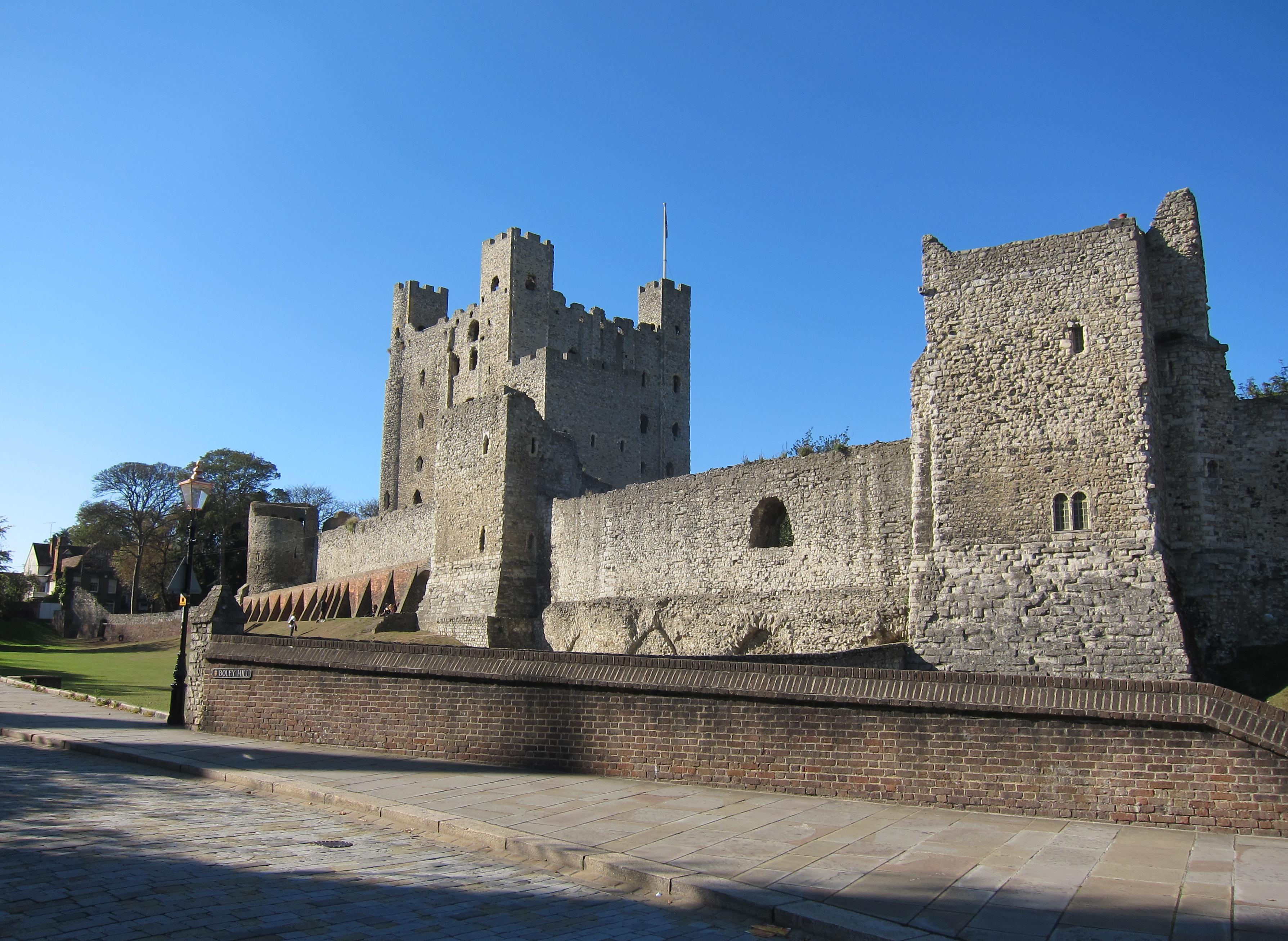
Rochester Castle
Only six days after the completion of the second day of our walk on the Saxon Shore Way, Tosh and Harold joined me for day three. We were promised another sunny autumn afternoon, with temperatures in the low seventies. In the event, we had a rather cloudy day, with only a little sun, and temperatures in the sixties. Still it was good walking weather and we were anxious to keep up the rhythm of the march.
There was no point in aiming for a precise starting time at Charing Cross, since there are so many trains to Strood, and so we had just agreed to meet at 9:00. The Lees were in the bowels of the tube station when I caught up with them at about 8:50. We bought our tickets and got some coffees and Danish to go – and were all set to board the 8:57. In the station there was a group of ramblers, also heading for Strood, and Harold and I talked to one woman in a yellow sweater and grey bicycle shorts who was heading our way.
I did notice one ominous entry on the TV screen that announced our departure – a section of the route would have to be completed by bus because of engineering works. Still, we were making a much earlier start than usual, and we didn’t mind too much having to detrain at Dartford. Tosh took umbrage at Connex Southeast when she discovered, however, that there were no working loos on our train. We were among the last passengers to find seats aboard the “direct” bus to Gravesend – it took long enough to negotiate the ten miles or so and the bus seemed to do a complete circuit of the city of Pocahontas before bringing us to the railway terminal. Here we boarded a train for Strood, arriving almost half an hour late. We were able to begin our walk at about 10:30.
It was nice not to have to depend on taxis for once. We could stride right down the station access road, onto to the high street, and – turning eastward – cross the Medway on the Rochester Bridge. The latter had been repainted; flesh-colored ceramic lions holding shields were perched atop the ramparts of this bridge. You could see right up their bums as you made your way to the opposite shore. Here we were in the precincts of the impressive castle and our route required us to circumvent its stone walls, beginning with a right turn at the Norman Conquest public house. There were a lot of references to street names in the guidebook on this half-urban day but unfortunately not every street was well-marked on the ground.
After the castle it was time to visit the adjacent cathedral and here we actually stepped inside; a priest with a pamphlet rushed up and offered us welcome. The ladies of the church were having a go at an ornate flower display. We didn’t linger long (Harold had brought Grinnell students here) but I suggested a small detour to the famous Rochester High Street, where we could see the Dickens industry in full force. Pubs were called Expectations and Dodger’s; there was a Peggoty’s tearoom and you could shop at Edwin Drood’s antiques. Cars had been banished and so we had a nice stroll, a little beyond the French Hospital, before turning back. Tosh had to sneak into a bakery for some goodies.
We passed the cathedral a second time, not having made much progress so far, and followed Minor Canons Row and some back streets through the King’s School. Uniformed teenagers were milling about sullenly and it made our hearts sink to see them following an academic schedule on a Saturday. We passed through a small park called the Vines; the stump of a dead tree had been carved into the shape of a monk – it was awful; nature should not be turned into kitsch. Our objective was Restoration House, which not only had Pepys and Charles II associations but had served as the model for Miss Faversham’s residence in Great Expectations. Once again I had brought my camera with me so I could take some snaps for Tosh.
We headed east into some rather sordid urban surroundings, down East Row, and Gravel Walk and up St. Peter’s Path, turning right at the Rising Sun Pub. This was the right direction, but we were one block too soon in our turning and it soon occurred to me that we were not encountering the landmarks mentioned in the guidebook. So we returned to the Rising Sun and started all over, continuing up to a busy highway and crossing a dangerous roundabout to enter a recreation ground. Views of the dockyards at Chatham were beginning to emerge as we climbed high above a street of Georgian terrace houses, past the tennis courts and the bowling green and the Kent College of Art and Design to reach the top of Fort Pitt Hill.
Once again a useful road sign was missing, but we turned left at the end of parkland, past the bandstand, and crunched our way over the chestnut tree debris (where I picked up the lucky conker of the day) before descending on a tarmac path to busy New Road. It took a while to scramble across this highway – using the central reservation as a staging post – and then we had to double back to descend Hammond Hill between the Unitarian Church and the Ancient Order of Foresters. This short steep descent put us onto the High Street of Chatham (not nearly as attractive as Rochester’s) and, after taking off our sweatshirts, we followed it for a few blocks before turning left on Medway Street and emerging on a busy corner full of traffic – with no useful street signs to help us out.
I knew we had to continue north, parallel to the river, but it was a struggle to reach pavement. We ended up in a park with no egress, had to backtrack a bit, passed a crowd watching teenage girls dancing to disco music on an outdoor stage, and finally left the bustle of Chatham behind us. A raised walkway put us a little bit above the traffic of Dock Road as we approached one of the ornate gatehouses of the Royal Dockyards. Here we turned uphill, our back to the river, and passed through an area that had housed military personnel in the eighteenth century. At the top of the hill we entered a parklike area known as the Great Lines. We were tempted to get on the wrong side of an open playing field fence here but conservatively we stuck to the roadway, which soon became blocked to cars. On our right there was a view of the war memorial obelisk – which appears very prominently as a setting in one of the sections of Graham Swift’s Last Orders, a novel both Harold and I had been reading.
When the parkland came to an end we took a sharp left to reach the high street of our third town, Gillingham. I had been fending off Tosh’s requests for lunch and a pub but, now that it was nearing 1:00, I told her we could begin our search. Unfortunately, there wasn’t much on offer. The town was having its Saturday market and progress was slow through the crowds. I told Harold that the chap who had started the Curry House had made a basic mistake when he bought the property – he though they said “Gillianwalla” instead of Gillingham. We went into a few pubs as we neared the train station but they didn’t serve food. Finally a guy in a wheel chair suggested we buy food in the Best Café and bring it into the Southern Belle pub. I suggested we just eat in the café, and so we did. The Lees had sandwiches (Harold, complaining of stomach problems, had a glass of milk) and I had a quarter pounder with cheese and chips. It was quite good for a greasy spoon, but the service was slow and the radio did squawk so. Tosh, however, was charmed by the down home comforts of the place.
After our meal we headed over to the station to use the loos; we got all the way down to the platform before discovering there were no loos. This settled the matter – we would have to go to the Southern Belle after all. I had a whiskey while the Lees had half pints. The place, which was decorated as an homage to Marilyn Monroe and other Hollywood icons, was full of friendly locals, including the man in the wheelchair, and there was an animating spirit in the form of huge Samson, the pub dog. The regulars all greeted this beast as they entered the premises. He came by our table for a cuddle too.
We didn’t linger too long, heading at last down Railway Street and turning off onto a run down street of terraced houses where a Saturday contingent was out working on their motors. We continued to accompany traffic as we made our way eastward, once again climbing above a small playground full of active kids to approach the church of St. Mary Magdalen, where a wedding was in progress. The bridesmaids, in russet colored outfits, were adjusting the costumes of the little flower girls as we passed by. We crossed a cemetery, where Tosh challenged a lady on a bench to name a nearby tree (“How should I know, I’m from London,” was the response). Then we doubled back a bit to turn downhill and approach the entrance to Gillingham Strand, a popular riverside amusement area where the Lees each had an ice cream.
There was a breeze coming off the water and we put our sweatshirts back on. We had covered only about half of our mileage to this point, but things would be much more straightforward, level, and easy to follow from now on. Leaving the toy train full of little kids chugging behind us, we continued eastward, winding in and out of the inlets at low tide. Occasionally we were driven behind warehouses, losing temporary sight of the riverside scene, but the route was now dead level and we were chalking up the miles pretty quickly. One of the inlets brought us to Sharp’s Green, where many people were exercising dogs while wrecks wallowed in the mud. After passing Bloor’s Wharf we turned north on the Motney Hill Peninsula, pausing for a brief sit down at the derelict cement works, with Rainham Creek bubbling up beneath the embankment.
Around the corner was the hulk of the wrecked Athena and inside a roofless factory chamber we found an interesting graffito in a lurid blue green: “I Am A Grey Romantic Trapped By Insanity. This is No Prison; This is My World.” We continued north, parallel to a road, before dropping down to join it for a brief climb up to the first houses on Motney Hill. The air seemed to be flavored by sewage here. A stile put us into a plowed field. Tosh disdained the clearly marked path around the perimeter of this space and trudged forward in the earthy furrows to the far side. I paused for a final quiet pee while the Lees climbed a raised causeway that we used to head south, at last heading in the direction of our train station. Again there were many wet dogs accompanying their strolling owners on this section.
I had done some research into escape routes from the SSW here, but the first possibility didn’t seem to be at all clear on the ground. After we had rounded a corner behind some buildings, however, I did see a likely looking footpath heading off in a southwesterly direction inside a pear orchard. I paused to pick up some windfall fruit for Dorothy as we neared the highway. In fact we were on the wrong side of a fence but there was only one low barbed-wire strand to hop before reaching the roadway.
We headed west along a verge, stepping aside to let the traffic whiz by for the next several hundred yards, encouraged at the end of this stretch by the sight of Station Road, where we turned left for a fifteen minute walk into Rainham. We passed gnome filled front yards and more fruit trees, sometimes with sidewalk and sometimes without, as we made our way south. Soon we could see the bars being lowered at the level crossing; one westbound train and one eastbound one passed before we reached the spot ourselves. It was just going 4:30; we had walked eleven miles, and there was only a six-minute wait for a stopping train to Victoria.
In this time Tosh managed to get the station manager to open the loos (he protested that he had to keep them locked because kids messed about in them). When she returned I took her picture on the station platform – for by reaching Rainham she had completed her 1500th mile on British footpaths. She celebrated by eating a Kit-Kat as we settled into our napping positions in an ancient side-door train carriage. I slept the last forty minutes of this long ride, waking up only as we neared Battersea Power Station.
I made quick connections on the underground, changing at Oxford Circus, and was home by 6:30 after another successful outing. Nevertheless at an early hour I was quite ready to try out the new mattress – which had been delivered that afternoon.
To continue with the next stage of our walk you need: