
July 30, 1998: Faversham to Herne Bay
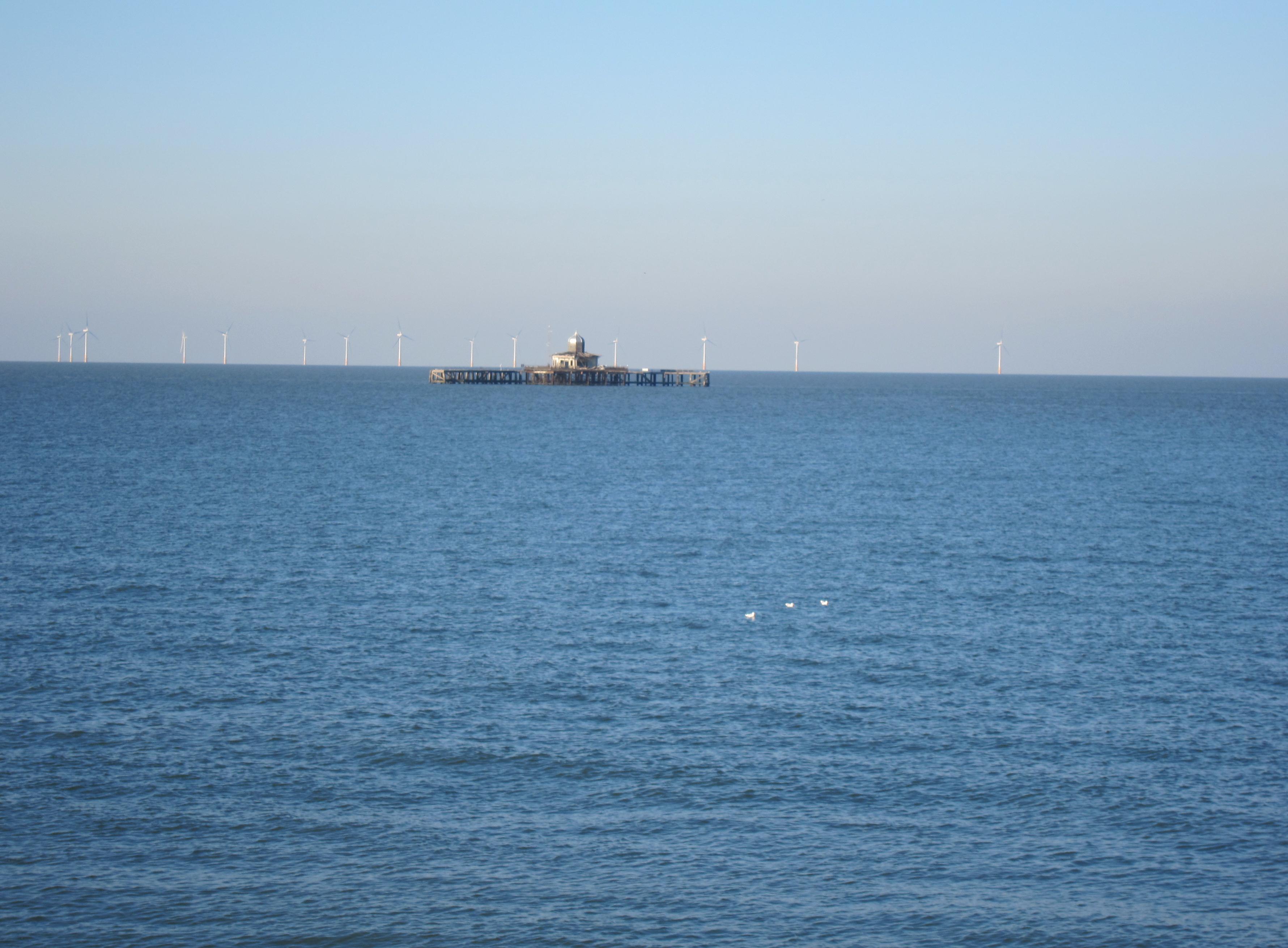
The surviving pier head at Herne Bay
Although the weather forecast for Thursday, July 30th, was not encouraging – with showers a likelihood throughout the day – the Lees and I decided to take a chance on the next stage of our Kent walk. We wanted a conditioning hike as we readied ourselves for a four-day expedition on the Thames Path eleven days later.
For me the walk was an additional time of testing, for it was the first walk I would attempt after having had two arteries re-plumbed by angioplasty on June 18th. The need to recover from this procedure had lead to the cancellation of our usual end-of-June walk on the South West Way, and I was quite anxious to get back into the rhythm of walking. For Tosh, too, this day’s walk was a milestone, for it was her first as a retired schoolteacher. This meant that after we had secured our tickets (there was a Schnauzer in line ahead of me at Victoria, but ours is now too feeble to undertake long walks), and after the Lees had finished their cups of coffee, we could climb aboard the 8:33 and, while I drank a cappuccino and munched on an almond pain au chocolate, I could bring the Lees up to date on all the school gossip which they might have missed. I gave Tosh a fossil I had bought for her at the beginning of the month in Alexandria, Virginia.
The trip to Faversham took about an hour and ten minutes. We used the station loos (Tosh reported the following quatrain from the walls of the ladies: “Sex is evil; sex is a sin; sin is forgiven – so get stuck in”), and bought some candy bars in the station shop before slowly making our way, at about 9:50, through a quite charming town, free of the great pedestrian jam that market day had brought with it on our last visit. We continued north past the heritage center – which occupied the site of the house of mayor Thomas Arden – whose murder by his wife in the mid-sixteenth century had served as the plot of an Elizabethan play.
We made our way through boatyards and walked along Faversham Creek, the last of the many inlets that the Saxon Shore Way follows on its twisting route. The sun was out, although there was plenty of cloud as well, and, after crossing a footbridge and the sewage outfall, we paused in a field to take off a layer. I walked in maroon t-shirt and taupe cords for the rest of the day. We left the boats behind us as we approached Nagden farm, chatting away as we followed a footpath sign and a dirt road north. But I soon sensed that we were too far away from the Creek and it was necessary for us to go back about a hundred yards to find a turnoff (rather well-disguised) through the farmyard and up onto a dyke above the creek – which was almost dry at low tide. This brought us to a section of the South Swale Nature Reserve, where Tosh, full of geology lore from her Open University course, left the dyke to have a look at the mud of the creek bed.
We were heading in the exact opposite direction needed for today’s section, west instead of east, but this was necessary to bring us back to the confluence of Faversham and Oare creeks (the third time we had been at this corner). Here we turned right to head north, toward the Swale and the ubiquitous Isle of Sheppey across the channel. In a few minutes we had turned again – this time eastwards – and were at last headed directly toward Herne Bay. It would be a long day’s march but very pleasant. There was a light wind blowing, but it was not chilly and the ominous clouds seemed to be concentrating on the Essex side of the Thames mouth; we could actually see rain falling up there, but on our side of the river all was bright and often sunny.
Tosh paused to chat with a bird watcher at a second nature reserve; he explained how the groins kept the sea from washing away the shingle of the beach. We paused once on the grass of the inland side of the sea wall for a snack of cookies and water. My feet were feeling hot and when I pulled off my socks I decided to put some tape on the balls of my feet, which were getting red from the friction of a rather rapid advance.
We had been going for close to two hours before we spotted the pub we were aiming for – as with other landmarks on the horizon of a exceptionally clear day, it seemed to take quite a while for us to reach this goal, but at 12:30 we were almost there. I was a bit worried because there seemed to be no cars about, but some lights at the back of the establishment promised that the place was open. As we dropped off the sea wall we could see a mini-caravan camp and some beach cabins but not much sign of life; indeed the welcoming lights now turned out to be the sun glinting off the pipe work. Nevertheless as we walked around to the front of the Ye Olde Sportsman Inn we found an open door and we were soon able to have a rest and down our lager. I took my boots off and let my hot feet cool down a bit.
Tosh had the chili while Harold and I had fish and chips – very fresh and tender cod indeed. The proprietors had been in charge of the pub only for a few weeks and were trying to establish some regular hours for this rather isolated site in what I called Seasalter Ex Urbis. There was one couple who were leaving as we arrived and another arriving as we left, but for the entire period of our stay in this establishment we were the only customers. Two tropical fish tanks had been embedded in the bar and the chain-smoking proprietor was checking out some new arrivals. After a week in Durham with fellow students on her geology course, Tosh could now drink a pint and a half at a sitting.
We left the pub at about 1:30 and continued eastward, losing the sea wall and having to take to the road through a rather depressing string of chalets and caravans as far as Blue Anchor corner. Off to our left the Isle of Sheppey, our constant companion for many days on this route, finally came to an end; at last there was nothing but the open water of the North Sea on our left. We were now in Seasalter proper and able to take advantage of the first of a number of seaside promenades in an increasingly suburbanized setting. It was warm now and I noticed that I was leaking. Perspiration from my California cap was falling down behind my glasses and hitting me on my chin.
We crossed the railway line and returned to road walking for a bit, but Seasalter’s Rose in Bloom pub soon beckoned – and we went inside for some more liquid refreshment. The place was getting ready for a catered buffet and there was not much room for the casual customer today. We sat on tall stools for a bit at the bar but eventually decided we would be happier in the garden. Just as I was about to head back out the front door with my Diet Coke a ten second shower sent me back inside; then we continued out back amid the kiddy apparatus to sit at a picnic table. I took my boots off again. The Lees had coffee as we finally came to the conclusion that no one had actually paid for any of this. Tosh remedied this situation and after a nice rest in this elevated spot, with the sea at last advancing on the shore, we picked up our gear and moved off. It was about 3:00 now.
The Saxon Shore Way follows a tarmac path steeply downhill from the road here, offering two routes at the bottom. I chose the one over the railway line and through a lane choked with seedy one-room summer chalets in varying states of repair. There was a golf course on our right and some builders were discussing how to save costs on some project by running in only one line instead of two. We now needed to return to the seafront and as we did so, at Lower Island on the outskirts of Whitstable, I told the Lees that I had just completed my 2800th mile on British footpaths; we took some pictures but I was a bit uncertain about the camera.
It wasn’t always easy to figure out what was required of walkers as we continued forward amid the trippers – using walkways and esplanades and dodging around buildings to reach the harbor at Whitstable. Tosh darted into a store to buy a scarf with knots on it for Marge Rogers. I used the time to walk up to the west end of the waterfront and observe the busy scene; fresh fish were on sale at a number of locations and a conveyer belt was creating a large pile of whelk shells which little kids were taking home in plastic bags (“I wanted some live ones!”). Tosh paused again as we neared some loos at the entrance of the east end of the harbor and I sat down in the shade on a cement wall for a little rest. We had covered ten miles, and still had another five to go.
We turned left off the main road, rounded a corner and began another long promenade above the groined shingle of Tankerton Beach. Bathers occupied headquarters among these structures and dog walkers in profusion descended the grassy hill from the residential area above us. We paused for another rest. I took my boots off for the last time, ate a Snickers bar, and drank some designer water. A plastic bag in Harold’s possession was lofted by the wind and sailed off in an easterly direction – with the geriatric eco-warrior in pursuit. I must say I didn’t think he could run that fast and he had to go some distance, even leaping over a bather amid the groins, before he reached his quarry in the surf. Tosh beamed her approval but I think sometimes there has to be a limit to one’s efforts in this regard.
We passed an outcrop of rare sulfur weed (aka hog’s fennel), home to the rare Agonopterix putridella moth. There was a brief return to pathway at Long Rock, where a tidal stream had cut an interesting channel. The Lees agreed that a second plastic bag, a red and white one, should be removed from the countryside and I had fears that we would now have to pick up every gum wrapper between here and Herne Bay (the Lees do patrol their own local park in this fashion), but when we crossed a bridge over a fouled streambed (there were warnings about a pollution incident) I teased Tosh that there was an offensive gas can that needed recycling floating there amid the muck, and she gave up.
Before us was the charming sight of Hampton, its houses rising in a little Mediterranean hill above the shoreline. There was a pub, the Hampton Inn, next to a prominent pier, but as we neared it (Tosh identifying the causeway rocks) it proved to be closed. We used some nearby loos and asked a passing gentleman if he knew when the pub opened, but when he said 6:00 we decided to press on. It was just past 5:30. A last stretch of seaside squalor beckoned us toward Herne Bay, whose pier head pushed out to sea in splendid isolation, the rest of the structure having been destroyed in a storm in 1979. Armies of day-trippers (including an all-black children’s battalion) were packing up and having their last chance at the rock candy store and the fruit machines. One seaside spot advertised that greatest of British culinary attractions: “Breakfasts all day!”
It was just going 6:00. I had long ago proposed that, because of the length of today’s walk and the lateness of the hour, we have dinner in Herne Bay before returning to London. Our first step was to have yet another drink so that we could consider the options. We followed Pier Street, an avenue that would continue on to the railway station, and at the corner of the High Street went into the Four Fathoms. Tosh and I had half pints and Harold a double whiskey. Underchallenged teenagers batted away at the pool table while their louche elders plied the fruit machines. I recorded the numbers of some local taxis (in case these were needed the next time around) and then went outside to do a survey of local eateries, many of which were already closed for the day. There was a sordid chippy and a fancy French restaurant that didn’t open for an hour, but right across from the pub was an Indian, the Gandhi, and here is where we ended up.
I knew that the trains left for London at 19 past the hour so we rather quickly decided to have a leisurely meal and try for the 8:19. I had a whiskey and then joined Harold for two Cokes. The bill of fare was quite extensive (though, of course, the Mahatma, whose picture adorned the menu, would have touched none of it) and the Lees know their Indian food. “Do you like eggplant?” Tosh asked me. “No.” “Okra?” “No.” “Spinach?” “Well…” “Don’t be embarrassed,” Harold added, “I wont eat any of those either.” I did find lychee and banana in some of the dishes, but everything was delicious. We were again alone for the first forty-five minutes or so, but then some locals started to arrive as well.
It would get suddenly dark in the restaurant as a bus would hurtle past the window but on three occasions there were driving showers outside as well. It was still spitting a bit as we left at about 8:00 and so I produced from my pack a brand new rain jacket that I had purchased recently at Eastern Mountain Sports on 61st Street in New York. The Lees, who had labored for years with my troublesome rain cape, were thrilled.
We didn’t have much of a walk up to the station and the train was only a minute late. There were some guffawing teenagers (the girls having quite literally forgotten what they were laughing at) but they departed at an early station, leaving the rest of us to doze until we arrived at Victoria at 9:30. I made my way stiffly through the station and descended to the underground, waiting for a long time at Oxford Circus for a Bakerloo Line train. It had rained a lot in London this day but it was dry enough as I made my way home after a very successful re-entry to the world of walking.
To continue with the next stage of our walk you need: