
August 13, 1998: Cricklade to Kemble
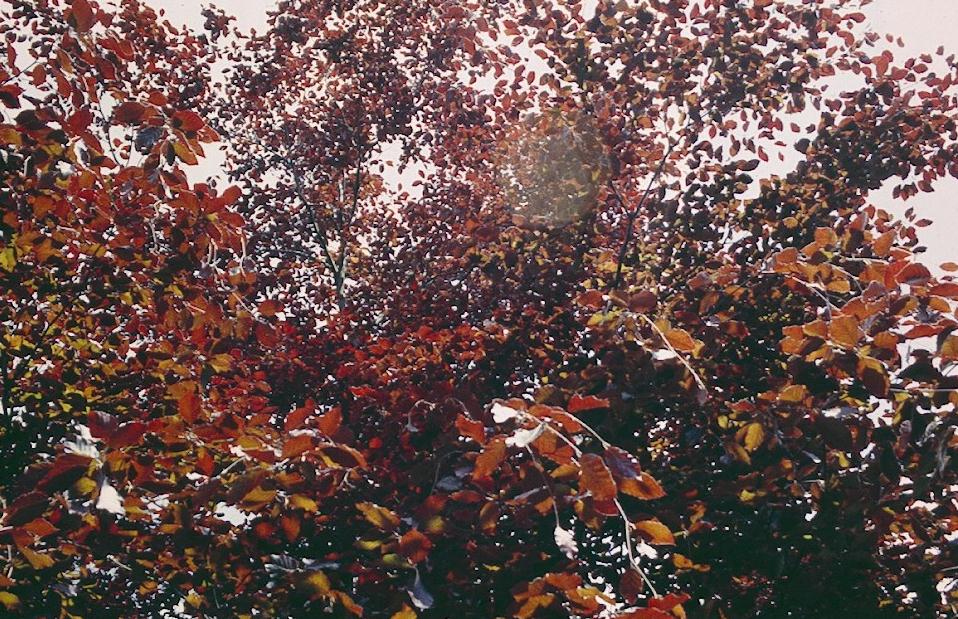
A great ornament of the countryside – the copper beech
I didn’t feel too sore on the morning of our last day on the path, getting up, as usual, about 6:00 and slowly completing my ablutions (still the goatee effect over the injured jaw) and stuffing my pack. I had a few minutes before breakfast to dart over to the church and across the high street for some photos of Cricklade. At 8:15 I joined the Lees for breakfast in a little morning room, where I was served my best version of scrambled eggs on toast. Tosh had found her morning paper but after we had settled our bill she and Harold needed to make a long stop at the market for snacks. Nevertheless we were able to make our getaway by 8:50, an early start dictated by today’s walking strategy, which called for lunch in Somerford Keynes and an early, fast train back to London from Kemble at 4:45. We could have opted for the 6:08 and had a much more leisurely start to the day, with lunch in Ashton Keynes, but when I told the Lees that they would have three changes of train with the 6:08, they opted for the earlier departure.
There had been extensive changes to the route on this westernmost portion since publication of Sharp’s 1981 guidebook. I knew, therefore, that it would not be useful to rely on it any longer and I placed the National Trail Guide in my map case, which I carried for the rest of the day. This was opened to the relevant OS maps– the text being of little use to us since it is written for west-to-east walkers. In the event, for most of the day, it was easy to follow the route relying on the maps only; waymarking on the ground was good.
In pale sunshine we headed back to a bridge over the Thames but turned off before reaching it to travel through back streets and housing estates before finally crossing the infant stream. It accompanied us on our left for quite some time – our last chance to see all the swan families and their well grown grey cygnets, sometimes as few as one, sometimes as many as six. After a while we were diverted away from the streambed and followed three sides of a square on forested bridle paths before rejoining the Thames.
We were now in reservoir country and the first of these artificial lakes, replete with its own island, now appeared on our right. On the whole these were rather well-landscaped bodies of water, with natural woodland left in position around the shoreline. One family was frying bacon in front of their tent and a water skier had the prospect of endless circles as he was pulled by a motorboat. We walked north between two of the reservoirs, then west again in warm sun. Everyone paused for a loo break. It was really quite lovely and surprisingly empty. We now darted around the southern end of a third lake and found ourselves among trippers and their dogs on the straight run to Ashton Keynes to the northwest. In this case, though blue stretched off to the distance on both sides of the path, the addition of more water to flooded farmland was so recent that these lakelets were not on the OS map at all. The gravel of the track between these dead stretches of reservoir was rough on the feet and we were glad to reach the sports ground of our village and pass over grass again.
Tosh had her mind set on morning coffee but, although we left the route for a little bit to see if we could find any life in the town, we could not. So we re-located Back Street and at 10:30 we were outside the well-closed Plough Inn. Tosh’s back was bothering her and she did stretching exercises against a wall (when she was not scraping away at it for archeological purposes), then joined us on the grass of the pub’s back yard, re-stuffed her pack to distribute the weight better and ate a Kit-Kat bar. (I disdained a fifth free finger, which she had gotten with her morning purchases in Cricklade.)
We had a nice rest and then continued west on Back Street, passing through suburbia, with the Thames stream once again an accompaniment. This was actually a delightful, easy portion of the route, well-shaded throughout. Reservoirs again appeared north and south and a bit of surviving woodland, Freeth’s Wood, appeared on the south side of the track. We crossed from Wiltshire back into Gloucestershire and turned northwest again – using dirt roads to move quickly toward our noontime pub. Two gents, walking southeast, joked with us as we passed them, “You’re heading in the wrong direction!”
I disdained the road route into Somerford Keynes, following the path itself as it used a highway verge before turning off into Neigh Bridge Country Park. Some gypsies with their horses and wagon were encamped on the verge across the highway. The Park also has its reservoir and we climbed a hill (after figuring out what side we needed to be on) and had a rest on a bench with a nice overview. The Thames was now on our left as we continued northward on field edges for another fifteen minutes as I searched out a public right of way over to our village. Its line had changed slightly from that pictured on the OS map but I was certain we were heading in the right direction, that of the church. “Is that the church?” Tosh wanted to know, “No, Tosh, that’s a copper beech.”
We skirted a harvested hay field and headed for a gap in a hedge, crossed a stile and over a field to approach the churchyard of Somerford Keynes. Here I was improvising a route out to the main road, but the Lees fell rather far behind here, Tosh having become obsessed with the crystals in the stones of a local wall. I walked on gravel through a posh suburban alley and reached the road, crossed it and had a look around. Only a block or so to the south I could see the sign for the Baker’s Arms. I waited for Harold to appear, then made my way down to the pub. A member of the kitchen staff said, “You’ve got a straggler back there – I doubt he’ll make it.” “And there’s another one after him,” I offered. It was just past 12:00.
Workmen were busy with the external electrics of the pub as we entered its posh precincts. The fussy publican reminded us that he usually had a “boots off” sign – but he had just taken it down, as it was dry. The irony is that I would have been glad to have taken off my boots today and often did so on this trip, unbidden, just to cool off my feet. Almost every table in the joint was booked for luncheon but we were directed to an unclaimed empty spot and settled in to study an extensive menu. I had lamb rogan josh and drank a pint of lager. Although two gents were listed as licensees (shades of Amos and Henry of Emmerdale fame) our chap seemed to be the only one on duty, fawning over the ancient gentry who gradually filled up the place. At times there was a queue ten people deep at the bar and I was glad we had gotten in just ahead of the rush. Tosh noticed that one man at the bar was using an amplification device which he held to his throat, the same machine her father had used for fifteen years after throat cancer – and she had to tell him how many memories were flooding back at the sound of his artificial voice. I didn’t want us to dawdle, with a train still to catch, but the table service, provided by a beautiful dark boy, was excellent. We were able to use the loos and leave by 1:00.
We retraced our steps, had a look at Tosh’s crystals, and were soon heading north with the streambed of the Thames on our left. We walked along field edges and over many a style (how carefully I took these today). My ribs were really beginning to hurt me now and walking was not too pleasant; there was some relief if I hoisted my back by putting my hands behind my pack, but that left the map case to flutter against my legs.
We passed Old Mill Farm and reached the old windmill of Upper Mill Farm. At the stile near the farmhouse there were lots of signs telling us what we couldn’t do on this property, including taking photographs. This was an instruction I was prepared to ignore because I needed to pose Tosh against a willow tree in honor of her having just completed her 1600th mile.
We continued north on narrowing paths, often overgrown, as the last of the afternoon’s sunshine seemed to disappear. Heading northwest into Ewen we walked over some fields, beneath some electricity pylons, and behind some rather elegant houses. It was the last time I was able to observe any water in the Thames this day. Then, leaving the streambed behind, we reached roadway, climbed up to the village and turned west for twenty minutes of road walking on the verge (I think there is a parallel off-route path protected from the traffic – but we didn’t spot it until it was too late.)
At Parker’s Bridge we turned north and then northwest again, enjoying our last association with the Thames watercourse on our left. Our route lead up to a road, which we crossed carefully, and then, after crossing a footbridge, we faced our final mile, an uphill slog (after all those level miles) across grassy, muck-filled fields. Waymarking was not much in evidence and the Lees veered too far to the right once and, after Tosh had scouted out a sign pointing uphill next to a hedgerow, we veered too far to the left – following the foliage all the way up to the next highway when we should have aimed half right to reach a stile. I was a bit nonplussed when we climbed onto this roadway by the absence of any obvious continuation – but Harold had spotted a stile off to our right and we corrected our line. There now followed a mostly level ramble along a track, on which cows were having a siesta, and took a final half turn to the right to cover the last fields before reaching the small plinth placed above a hollow where, in certain seasons, the source of the Thames flows forth. It was 3:30. It had taken me ten years but I had finished my fifteenth British footpath – and one of the longest at 177.5 miles.
Tosh seemed to be a bit disappointed with the site (“There was water in the Mississippi’s source when my father took me there.”) She picked up a few rock samples, but we didn’t dawdle for long. We straightened out the wrong turns we had made on the ascent and were soon plunging downhill – though Tosh complained that the only thing you could look at on such a surface were your feet – otherwise you would be stepping into cow muck.
Just as we neared our second highway I set the others to looking for a shortcut route over to Kemble Station, one that is clearly marked on the OS map. This was located just as the sun came out again and we had a warm crossing of a field of cows up to a road to our west. From here the turnoff to the station could be seen at the top of a little hill and we climbed it, entered the station parking lot, and made our way up to the platforms. It was 4:05.
A garrulous cab driver who claimed to have served on the Atlantic convoys, told us how long we would have to wait for a train, then apologized abashedly when he looked up the time we gave him – which proved to be correct. There was a nearby pub and Tosh was interested in seeing if it might be open, but no one followed her when she climbed to the other side of the platform before – returning with the news that it was closed.
Harold and I were just as happy to relax. I put on my purple sweatshirt, swallowed some Tums against my noontime rogan josh, drank some water, and endured the chatter of other trainwaiters on the subject of last night’s episode of Ally McBeal. Our train arrived shortly after 4:45 and we were soon ensconced behind a table for four, sharing the spot with an accommodating professional woman on her way to the Smoke. We dozed a great deal and then I looked a little bit at the Lee’s paper (Monicagate was about to blow up for Bill Clinton). The train was full of noisy kids clamoring for parental attention. My walking companions departed at Reading and I had the last half hour alone (except for the phone calls from the lady opposite), arriving at Paddington at 6:08, on time. I bought a ticket for Maida Vale and had to walk down the stalled escalator, every step hurting my bruised ribs, then shuffle slowly the long four blocks needed to reach my street.
A more sensible person would have called off today’s venture, and the Lees would have understood, but – being so close to the end, and having been responsible for one cancellation for them already this summer, I was determined to get this one finished. As so I did. I had a long drink of scotch and Dorothy and I ordered pizza as I began another lengthy period of post-walk convalescence.
Long after we had completed the route additional territory was added to the urban sections of the Thames Path near London. If you want to read how we walked the new stage (albeit in the opposite direction from our usual line of march) you need: