
October 22, 1986: Bakewell to Elton
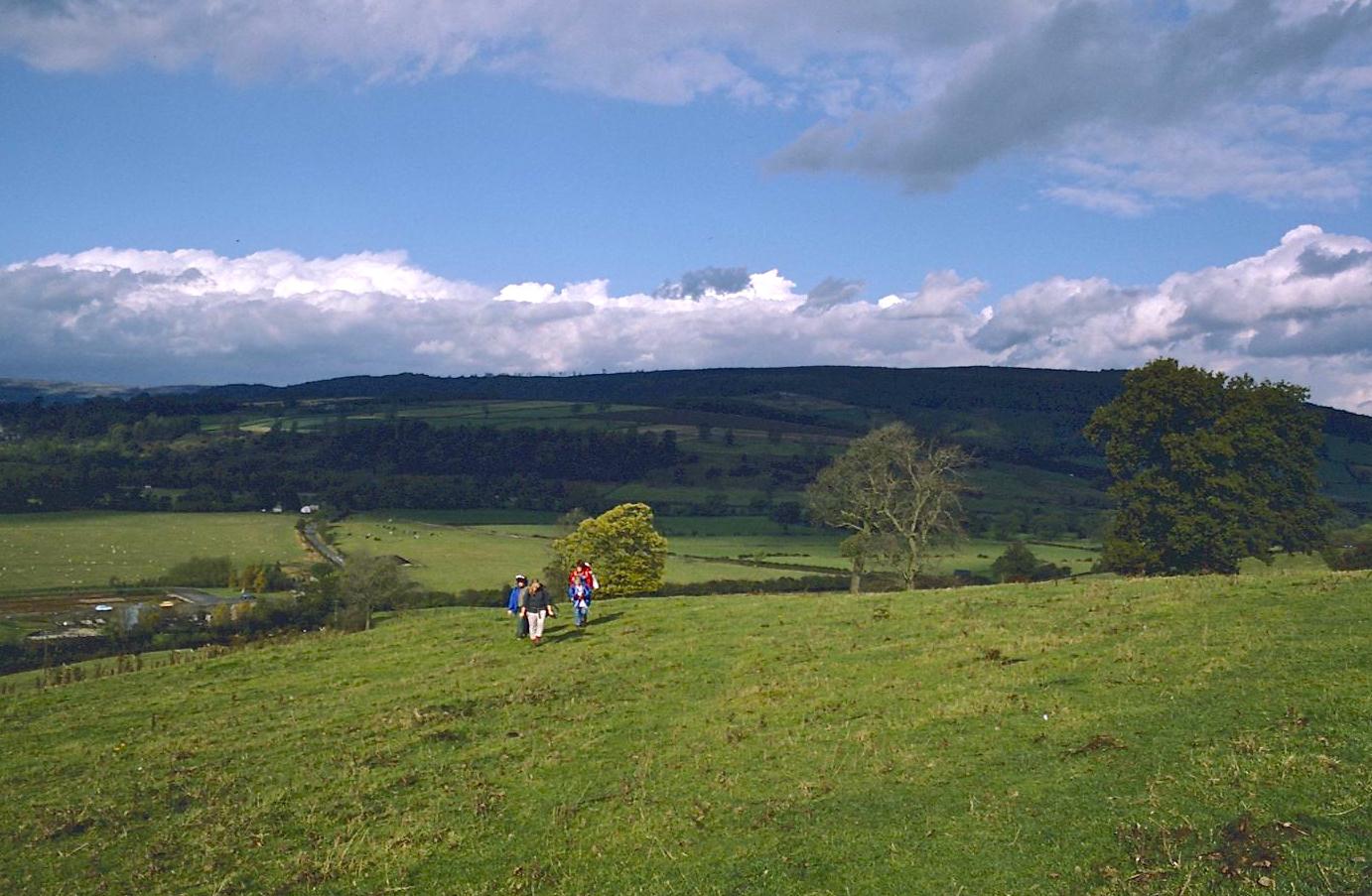
Climbing up to Stanton-in-Peak
On Tuesday, October 21, 1986, Tosh and I, once again acquitting ourselves of our Alternatives responsibilities, began a five day excursion with a party of eleven students from the American School. Two years earlier we had experienced a troubled walking episode on the Cumbria Way. The memory of dragging eighteen unprepared and uncooperative adolescents over Lakeland’s hills and dales had been so bitter that we had determined not to repeat the experiment and in 1985, therefore, we sat for three days in a darkened classroom with 40 unresponsive and bored teenagers – watching comedy films. This sequel was enough to convince us that we had better try the outdoors one more time. My choice on this occasion was Derbyshire’s White Peak Way, for here there were plenty of youth hostels at just the right intervals for a four-day march. In order to be in position for the first stage it was necessary for us to leave directly from school on Tuesday afternoon.
I had made several changes in my planning for this Alternative, hoping to weed out as many impossible candidates as possible. In the description booklet I had stressed that everyone had to share in the responsibilities as well as the fun. Not an Alternative for loners or quitters. Begin by getting the proper raingear and footwear. In the event, three boys and eight girls listed the walk as one their first choices. Our group had met twice during homeroom and I had met many of the parents on Parents Night. I gave each walker a detailed packing list as well as rules for the trail and the hostel. Tosh and I reminded everyone of the necessity of staying in single file on the roads, of keeping in touch on the trail, of curfew rules at the hostel. Haunted by memories of our uneasy vigils last time, I had insisted that anyone leaving the hostel must, in person, inform me of this decision. The no alcohol rule was stressed in our meetings and in an all-school assembly. There did not seem to be anything more we could do to set the right tone for our travels – but I suspect that Tosh and I were both quite apprehensive.
All day Tuesday I waited anxiously to check in my charges – who were bringing backpacks to be stored in Blue 6. Only Julie Galun was missing, but I tracked her down in her science class. Yes, they had all remembered to bring their gear. At 3:15 they started to drift into my classroom. I was hovering anxiously. I walked down to the commons for a drink of water and here principal Clayton Lewis stopped to admire the wax shine on my old boots. (This did not make up for the fact that our earnest but forgetful principal had earlier chided Tosh for wearing jeans to school; the flea is still in his ear).
At 3:30 we pulled on our packs and headed for the library steps. Here was Clayton again, wishing us well. Tosh reported her delight over his presence: she felt that the sight of two senior faculty members bravely marching into the drizzle with pack on back would prove instructive. At least we reached St. John’s Wood tube stop without having to put on our raingear. As we began our descent on the famous escalator one of London’s angry citizens, rising toward the street on the opposite side, used his fist to punch out the glass on one of the hanging advertisements (regrettably, it was the ad with the faces of the famous victims of Parkinson’s disease). “You’re all shit,” he shouted to those below, though none of the chattering students seemed to have noticed this incident. We were soon aboard a Jubilee Line train heading south; in the next compartment another student group was on its way to Waterloo. At Baker Street we switched to the Circle Line and shortly after 4:00 we were in St. Pancras Station.
I gave everyone fifteen minutes to buy snacks and use the loo. During this period I travelled the length of platform two in search of our carriage. Near the front of the train I located Car B. Inside I could see all the little white cards of the seat reservation system. At 4:20 I headed our group back to this spot and everyone chose a seat. There was no shortage – since there seemed to be over twenty seats reserved for our group of 13. Tosh and I sat opposite one another for the one hour, forty-five minute ride to Derby – a fast trip on a comfortable train. The kids read the newspaper, played cards with matchstick stakes and gossiped. I was a little worried about Paul Herzog, a shy tenth-grader in glasses and Syracuse sweatshirt. He had such a tiny pack that he had to carry his coat over his arm. He sat by himself reading The Independent, but later he joined the others and got on quite well. I thought he was a very nice kid.
We reached Derby at 6:10. Tosh had been trying all day to see if a wine bar in Bakewell would serve us some food on this night – for we would certainly arrive after evening meal time at our hostel. This should have been done the day before, but she had forgotten. Now, on the Derby platform, she once again failed to get a response, so we were faced with the problem of finding some way to feed our teenagers before reaching our place of accommodation. Outside the station I found Bert Sutton, sitting behind the wheel of a large bus. He and Tosh and some friendly taxi drivers began a discussion on suitable feeding stations in Derby. Eventually Mr. Sutton decided to drive us to a local McDonalds. This was near the bus station, where he could park; it was extremely kind of him to wait for us for the hour or so it took us to get fed.
It was spitting a bit in Derby too. We walked through the bus station and got directions from a lady newsvendor. We were directed through a pedestrian shopping precinct and soon found the cheery yellow glow of those familiar golden arches. The kids seemed delighted by this solution and they all queued up to give their orders for McNuggets, burgers, fries, and drinks. The bill came to £27. The girls behind the counter were not at all daunted buy our unusual party. Everyone seemed to enjoy the food, though Tosh kept apologizing needlessly. Lamya Al-Malazi, our vegetarian, managed to get down a large order of chicken McNuggets. Nick Levine and Rodney Stevenson, two twelfth-grade rugby players, insisted on buying Ronald McDonald mugs. Some kids with red balls on their noses came in on their way home from a party. Upstairs another party was in progress. On our way to the loos we could see children circling the floor in a round dance, a charming sight.
At about 7:30 we were ready to leave. Mr. Sutton was waiting patiently for us back at the bus station and he was certainly nonplused when Tosh, forgetting where she was, said to him, “We should have brought you a malt” – which would have been a rather strange present for a man who was about to drive us off into the darkness – if read as an abbreviation for malt whiskey; Tosh, still in her McDonald’s mode, was undoubtedly still thinking of the American milkshake.
We saw none of the countryside, unfortunately, as we bustled northward. Just as we reached Bakewell, Anna Levine began to complain of motion sickness. Matters were not helped by the tortuous ascent to the youth hostel, nor by the jerking motion of the bus as Mr. Sutton maneuvered it into position to let us off. Anna departed first, convinced that she was being persecuted by the driver, but she was soon her old chatty, smart-alecky self, a fifteen year-old who had earlier declared that she would one day be America’s first female Jewish socialist president – I conceded the possibility of female and Jewish only.
I stayed behind with Mr. Sutton, going over details of our pick-up on Saturday, a 1:30 rendezvous on a lonely stretch of the A515 at Sterndale Moor (Days later I noticed that I had suggested we would reach the A515 just south of this village; in fact the White Peak Way comes out just to the north; in the event this mistake, which can be credited to the dim light of the bus in which we looked at the OS maps, didn’t matter one way or the other.) By the time we had said goodbye, all the others had disappeared and I was quite alone on pitch-black Fly Hill. I wandered down this street a while, trying to find the hostel. When I located the building it took me some time to figure out how to get in. Moments earlier, Tosh had fallen off a step out here and bruised her knee.
A very nice warden greeted me when I checked in at reception. From him I bought the last five White Peak Way patches available at this or any of the other hostels on route. He gave me all the relevant lights out and breakfast times and directed me to my dorm – where I found the three lads unpacking. Some of the girls wanted showers but they were discouraged by the fact that the indoor shower was broken and the only available substitute was in a cold shed outside. Little Becky Harrison, 14, informed me solemnly that she was leaving the hostel to use these facilities, but I believe she gave up. Lamya and Bridget Robbins also went on a five-minute excursion up the darkened street. They were back almost immediately.
Tosh now urged me to go into town with her, so we opened the door of the snug, where most of our lot were playing games, and advised the group of our departure. Lamya teased us by restating the no alcohol rule. Tosh and I had agreed, indeed, not to drink on this trip, and we were true to our word. I think our kids followed the rule too (this had been such a matter of anxiety two years earlier) – they certainly didn’t have many opportunities for pub life – but you can never state with certainty that you know at all times what teenagers are up to.
Outside Tosh and I tiptoed gingerly down the hill in the darkness. At the bottom we turned right, did a circuit of Bakewell’s roundabout, passed the wine bar that wouldn’t answer its phone, and checked out a bakery where we expected to buy some Bakewell puddings on the morrow. (The warden had been quite offended when we referred to these local delicacies as Bakewell tarts.”) I tried to use a pay phone, but it refused my coins. We then tried the Rutland Arms Hotel, where I had better luck in reaching Dorothy. The bar, in which we were the only customers, was quite pleasant. I had a lemonade and Tosh a black current spritzer. The friendly barman charged us a total of 50 pence and I suggested we add this place to Harold’s list of spots to have nervous breakdowns in.
Back at the hostel all was going smoothly. Conscientious Eden Silverman was trying to write in her journal and Heather Chandor was doing some reading for an English class. The rest were in the snug, chattering and playing cards. When 11:00 rolled around I suggested that it was time to call it a night. Lamya and the two senior boys, Rodney and Nick, kept up the chatter until lights out at 11:30. I never had to worry about the whereabouts of kids on this trip.
I took a sleeping pill and stuffed wax in my ears; nevertheless I had an uncomfortable night – worrying as usual about the weather and uncertain about the abilities of my novice walkers on what promised to be a strenuous day.
On Wednesday, October 22, we woke to clearing skies and I stepped outside the hostel to have a look at the enchanting sight of Bakewell in its valley setting below us. Breakfast was served at 8:30 and the kids pitched in with the cleanup chores soon thereafter. There were only four other people at the hostel; only one joined us at breakfast. When all the packs had been brought down I asked the warden to take our photograph in front of the hostel. Eden and Becky also had cameras, so the process was repeated three times. Spontaneously half of the female walkers crouched down to make a front row for lenses less wide than mine. As the girls had full packs on their back, I considered this squat to be well beyond the call of duty.
Shortly before 10:00 we walked down the hill and on toward the supermarket. Tosh was followed inside by most of the students as they selected a canned drink for the day. Some rushed to the chemist and Paul used the moment to buy stamps at the post office. Tosh then trotted off to the bakery for thirteen Bakewell puddings – these we stored for our elevenses. I thought we were ready to move but Heather, an eleventh-grade swimming champion, had crawled back into the market a second time. At 10:20 I had my first meaningful look at Robert Haslam’s The White Peak Way and lead us around the corner. We were launched at last.
We turned toward the River Wye (see also Kent and Offa’s Dyke for their versions of the same name) and found our way through the cattle market to the riverside. Ducks were bobbing up and down and Beckett Hood, an eleventh-grader from Texas via Yugoslavia, squealed with delight. (Poor Beckett – a really interesting and lively character who was killed, a decade later, in a motorcycle accident in Texas.)
We crossed two footbridges and reached the east bank of the river. Here we turned south on a track past the Agricultural Society office. When this ended we entered our first field via a metal gate. I suggested that all cuffs should be rolled up for the field was wet and the path, which lead us over several stiles, soon turned quite muddy. The views were lovely: the river meandering to our right, a line of autumn-touched trees climbing the hillside to our left. My prayer for a decent day seemed answered in full.
After a mile and a half we reached the end of the riverside portion of the walk. By this time we were ankle-deep in mud. To escape onto a tarmaced road required us to edge our way gingerly through a herd of curious cows – fortunately none of the girls showed signs of my wife’s Red River syndrome. A tractor towing a cart rolled up the hill ahead of us, a farm lad in a wool hat staring at us as though we were creatures from outer space. We began a steep ascent of the hillside and, for the first time, some distance opened up between the front of the group and the tail.
Haslam’s directions were proving to be very good indeed. At the appropriate spot on a hairpin bend we waited for the rest to catch us up. The litany began – “How many miles have we come so far?” I answered this question by suggesting that three gates would bring us to Bowling Green Farm and the two-mile mark. We decided, now that we had neared the crest, to look for a place for a rest. Shortly after a Y junction I lead us off the track and up a forest path where the pine needles seemed almost dry. We sat here for about ten minutes, eating our Bakewell puddings. It was beginning to cloud over and it was chilly up here. By the time we were ready to move a few drops had fallen and some of the kids even put on raingear.
We began a forested stretch and then a steep descent to the village of Rowsley. An Old English Sheep Dog, a local one, was sitting quietly with his master on this section. Only a few days earlier such an animal had made an appearance in chalk on my Sixth Period blackboard. “Anna,” I shouted, “here come’s your favorite dog.” At the bottom of the hill we reached a pavement that lead us by houses, many with gardens still in flower. I had a brief look at the village church. When we reached the A6 I started a search for the Peacock Hotel (we were standing next to it), having proposed to Tosh that we might see if they would take us in and give us tea. Brave Tosh, always good in such situations, barged in and secured the manager’s approval. She said he had taken a squint at us first – and pronounced us respectable. It was raining outside so it was quite a comfort to be ushered into the resident’s lounge of a very lovely establishment.
Coffee and tea arrived in short order, though I suppose the chief delight for the walkerettes was the availability of indoor toilets – it was dawning on some of them that the only alternative was the great outdoors itself. I slumped comfortably onto a sofa and drank my tea. “Do you think it’s still raining?” Paul asked. “Try looking out the window,” I proposed. It was still drizzling when I decided it was time to get a move on; we had covered only three and a half miles and it was already 12:30. Each of us now succumbed to the allure of rubberized outerwear. For the first time someone had the chore of helping me put my rain cape on over my pack. This task having been accomplished, we stepped out into radiant sunshine! For the next few hours, as we headed north into the hills on the west side of the Wye valley, we were accompanied by sparkling blue skies and truly marvelous vistas.
We edged gingerly across the A6 and followed the Stanton-in-Peak road round a few bends. Then it was through a gate and uphill on a grassy track. Near the top of this we headed across a field recently visited by the muck spreader. At the end there was a steep descent through a tiny patch of woods. Wet leaves made for a slippery surface and I was just thinking that my cane would be useful in such a spot; that is I was thinking this at about the same time that it dawned on me that I had left my stick somewhere in the comfy confines of the Peacock Hotel!
What a nuisance! Having already lost one walking stick to absent-mindedness this year I was determined not to endure a sequel. How nice it would have been to send someone, but there were no volunteers among my charges – mostly because none had confidence that they could find their way to Rowsley and back. Tosh, thinking quickly, ordained this hillside as our lunch spot. I took off my pack, hung map and camera on a tree, and scampered across the muck field once again. I made fast progress down the grassy track and quick-marched along the tarmac verge back to the village. School children were at play in the schoolyard now and one old woman, passed on our outward journey, was rooted to the same spot, waiting for a bus. I let myself into the hotel and returned to an empty resident’s lounge. There it was, the cane, hiding under the curtains. I grabbed it and left without anyone having seen my abrupt re-entry.
Somewhat breathlessly I retraced my route, the entire mission taking no more than 35 minutes. The kids were obviously ready to get a move on, so I paused only to get my gear. We crept down through the wood, crossed a little stream, and circled the hill below farmhouses while I looked for an escape route to a nearby road. Better directions from Haslam would have been useful here. Eventually I determined that we were supposed to pass through a farmyard. By doing this we had entered the hamlet of Congreve.
Our route obliged us to head down the hill toward the river once again, moving in a northwesterly direction. A signpost then suggested that we re-climb this same hill, heading this time due south. We crossed a field and a little stream on a footbridge to begin a quite steep ascent. I was sending Rodney and Nick ahead to look for spots that resembled the clues in Haslam’s book. Most of the girls were trailing well behind now; whenever they would catch up the plaintive cry of “Mister Linick” rose from their throats, but it was all in good fun and there seemed to be no weak sisters. The weather was still gorgeous. Below us Haddon Hall dominated the landscape. Ahead we were able to use the steeple of the church in Stanton-in-Peak as a guidepost.
We reached this village at last. I actually had a rest on a public bench next to the war memorial. We had covered five and a half miles, just past the half-way point, though, unfortunately, Rodney spotted a road sign indicating a mere three miles back to Bakewell. We straggled up the village streets, turning east for a steep climb to the top of the ridge. No one seemed to believe me when I assured them that the worst was almost behind us. At the crest we turned south-west along a track and soon entered a bracken-covered moorland on which purple heather still showed signs of life. At a turn-off we visited the Nine Ladies, an ancient stone circle – where we had a rest. As our party contained exactly nine ladies I could not resist posing each female before one of the standing stones for a group photograph. It says something about their good humor that they endured this project without complaint.
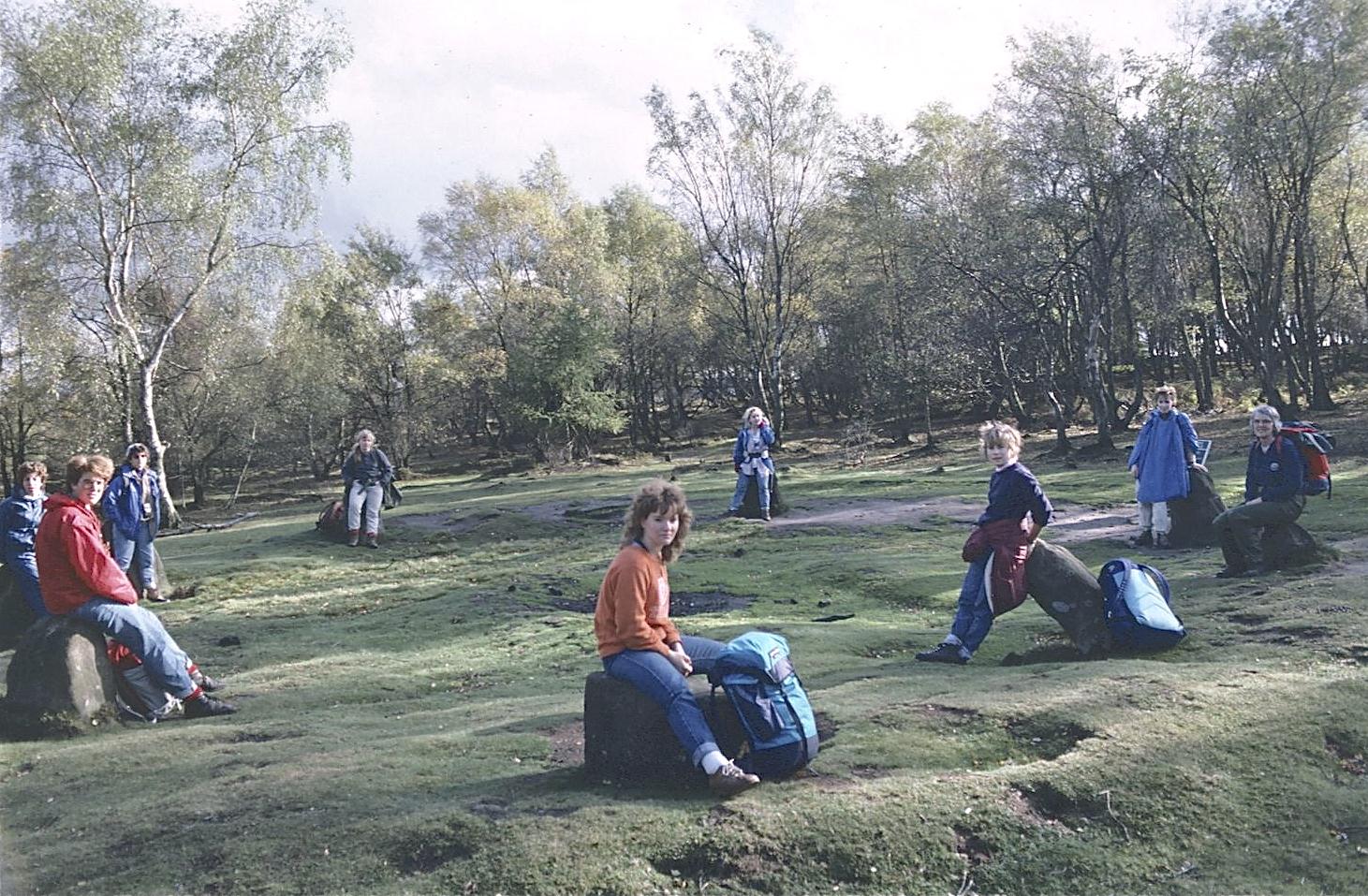
Nine ladies at the Nine Ladies
After the Nine Ladies we crossed to the eastern edge of the ridge and passed the Earl Grey Tower. I had to explain who Earl Grey was, more than once. The boys were all eager to move on, but the girls seemed to take forever to emerge from the monument. Sometimes, I learned, they fell behind simply to obtain some needed privacy. No one would ever admit to this need and, as a consequence, I was often perplexed by such unexplained delays. On this occasion heather picking seems to have been going on as well and Lamya walked the rest of the trip with antlers of heather sprouting from the top of her pack.
Another reason for my pique at this delay was that the good weather had suddenly disappeared. A thin mist was turning into a gentle rain and we had to put on our wet-gear.
At last it seemed possible to move ahead. I was searching for some sign of our next road and no doubt could have stayed longer on the moor itself had I not been so obsessed. We kept going in a southerly direction as we descended to the road in question; here it was necessary for the tail to catch up again. When it arrived I reminded Tosh, who usually had the responsibility for bringing up the rear, that we needed to make a bit more orderly progress. A brief bit of uphill put us over the crest and on our way down to the village of Birchover. We paused for a second to look into a quarry at some crossroads. A joking Rodney suggested we take a bus that was waiting in the village. Just beyond the Druid Inn there was something I thought would interest the students far more. To their surprise I left our track and began climbing up a narrow path behind a rocky outcrop. We had reached the Rowter Rocks.
As soon as the first fissure in the rocks appeared some of the kids disappeared into it. They came out on the other side, then began climbing up every available passage in this intriguing pile, much of which had been shaped not by nature but by the hand of man, Thomas Eyre, a romantic parson, circa 1700. There were wonderful views from this spot also, and the sun had come out again and, happily, we were never bothered by rain again on this day. It took me a while to get everybody down; every time Rodney or Nick appeared on another buttress Anna wanted to rush up and join them. Tosh found a tiny little rubber boot which we gave to Lamya as an ashtray. Bridget later discovered that Lamya’s lighter fit neatly into this toy and there it remained for several days. (Obviously, smoking was still permitted at our school; it would not be so for long.)
We resumed our descent, curving around a hill and down to a highway. It was slippery and muddy on this stretch and Tosh and some of the girls in rain pants slid down on their backsides. Bridget fell on her face, but remained imperturbable. We turned south for a short distance and then left the road for a farm track heading north again. I can’t remember a day with more backtracking! Our objective was the Hermit’s Cave but there were “no entry” signs posted where I expected to continue to this site. I sent Nick up a hill to see if he could make out any alternate way but he was not successful. So we continued up to the saddle, with the twin pillars of Robin Hood’s Stride on our left, and trudged forward in a northeasterly direction through two fields to our next road. Here we turned due south and climbed a long hill for almost half a mile. It was chilly and the afternoon sun was sinking, though it had been a glorious day.
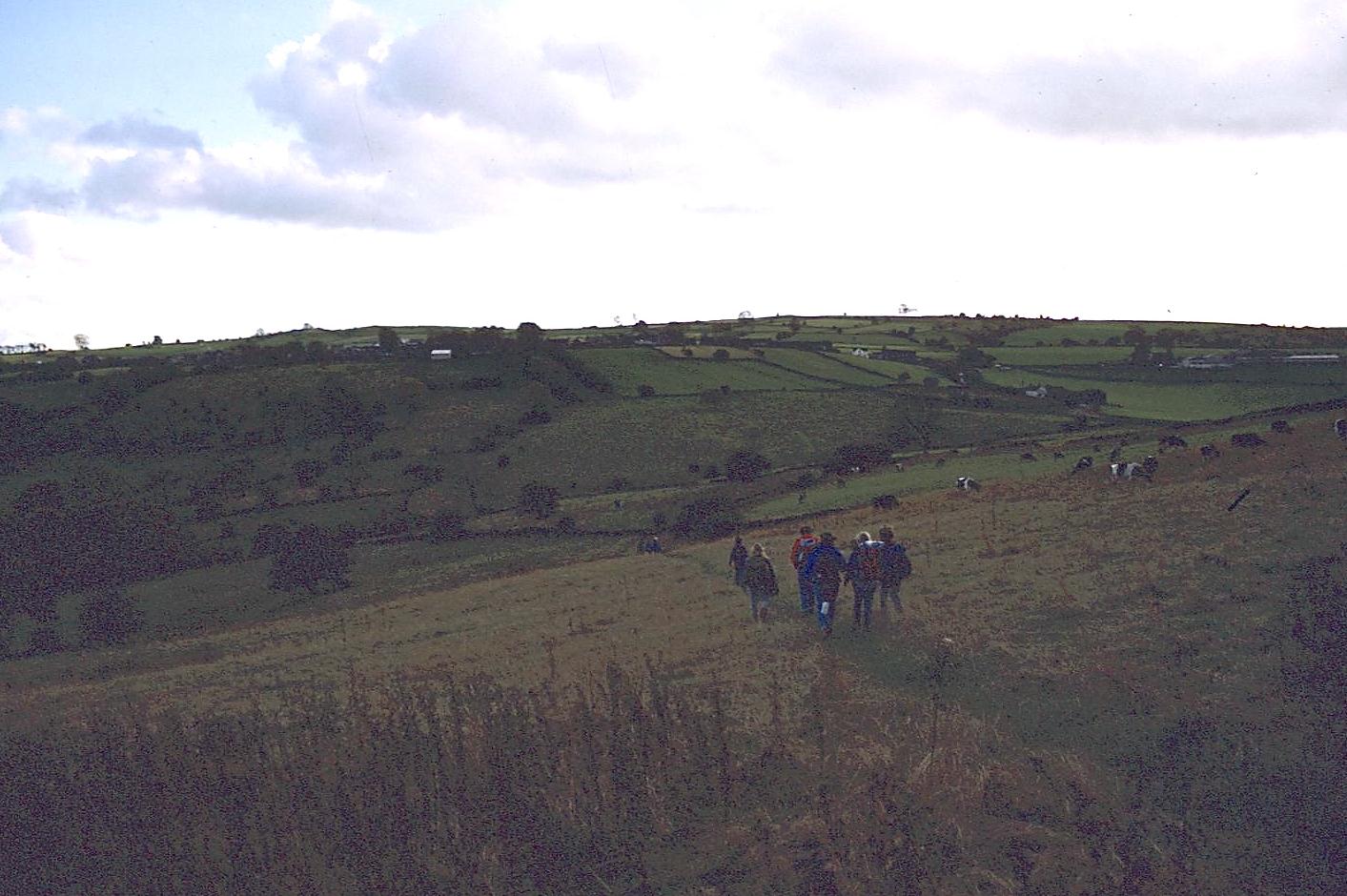
Approaching Elton
Almost anyone can pass me on a hill. By the time I reached the top of the road everybody had done so. Tosh and a forward party had reached a signed turnoff to Elton, our destination, and were making their last descent of the day. For once I brought up the rear. I had a few of the girls as companions as we sampled some blackberries. We could see Elton on the plateau above us and at last we began our final climb (“Missterr Linnnick!”). Tosh was hurrying ahead to reach the village store before it closed. Rodney and Nick ended up one field too far to the right at the head of the column and the result was that we all made our entrance onto Elton’s thoroughfare via a farmyard rich in effluent. We turned east and shuffled on to the Youth Hostel and here Tosh was just arriving with some provisions for tomorrow’s breakfast. An English lad and three girls were also waiting for the doors to open. Just as we pulled up, the warden, a tall countrywoman with a knee brace dangling below her short dress, emerged to open the gate. It was exactly 5:00 o’clock; I had timed this very complicated first day of walking just right!
We were required to take off our boots (and with good reason today) and carry them through to a boot room behind the kitchen. Then we carried our gear to the top floor, where there was a small men’s dorm opposite that of the women. The only other guests were two English kids – on half term break. The boy, 15, was quite a nice chap. He had been to both of the next two hostels and was able to give us a good report about each. What he had to say made them sound like luxury palaces compared to the simple grade unit in which we found ourselves this night.
I was very cold now, more so after Tosh and I went outside to use the telephone kiosk next door. For most of the evening I wore my coat and scarf, even my wool hat. The only place I could get warm was the common room. Here we were served sausage and chips and other simple entrees. The kids loved every minute of it. They played cards and other games. I gave a tired Tosh my walkman with Bruckner’s Sixth. I played Scrabble with several of the kids, including Anna. Then I introduced her to “Categories.” We spent more time worrying about the right categories than we did playing the games. Some nice desserts appeared. I bought a can of orange drink and nursed it through the evening – not wanting to take on too much liquid since the loo was three floors below our cold aerie above.
The boys, wanting to play darts, tried the Duke of York, but it was closed. They then walked down to the next village but they were not gone very long. I toyed with the idea of taking a shower. You had to get a key to the shower room from the warden; the switch was supposed to begin some sort of heating process but Bridget warned me that I wasn’t to expect much hot water. When I got none, I stood outside the stream and washed myself off from a distance.
As cold as it was the warden, quite a formidable duck, seemed to find it stuffy. She charged around opening windows that the rest of us had quietly closed. Then she chased the last of us upstairs as lights out approached. A radiator had come on with some heat, so things weren’t too bad in our little room but the wind was howling outside and I could not help worrying about the weather prospects on the morrow. “It snowed in this village two days ago,” one of the English lads chirped in cheerfully.
To continue with the next stage of our walk you need: