
October 14, 1987: Earl Sterndale to Ravenstor
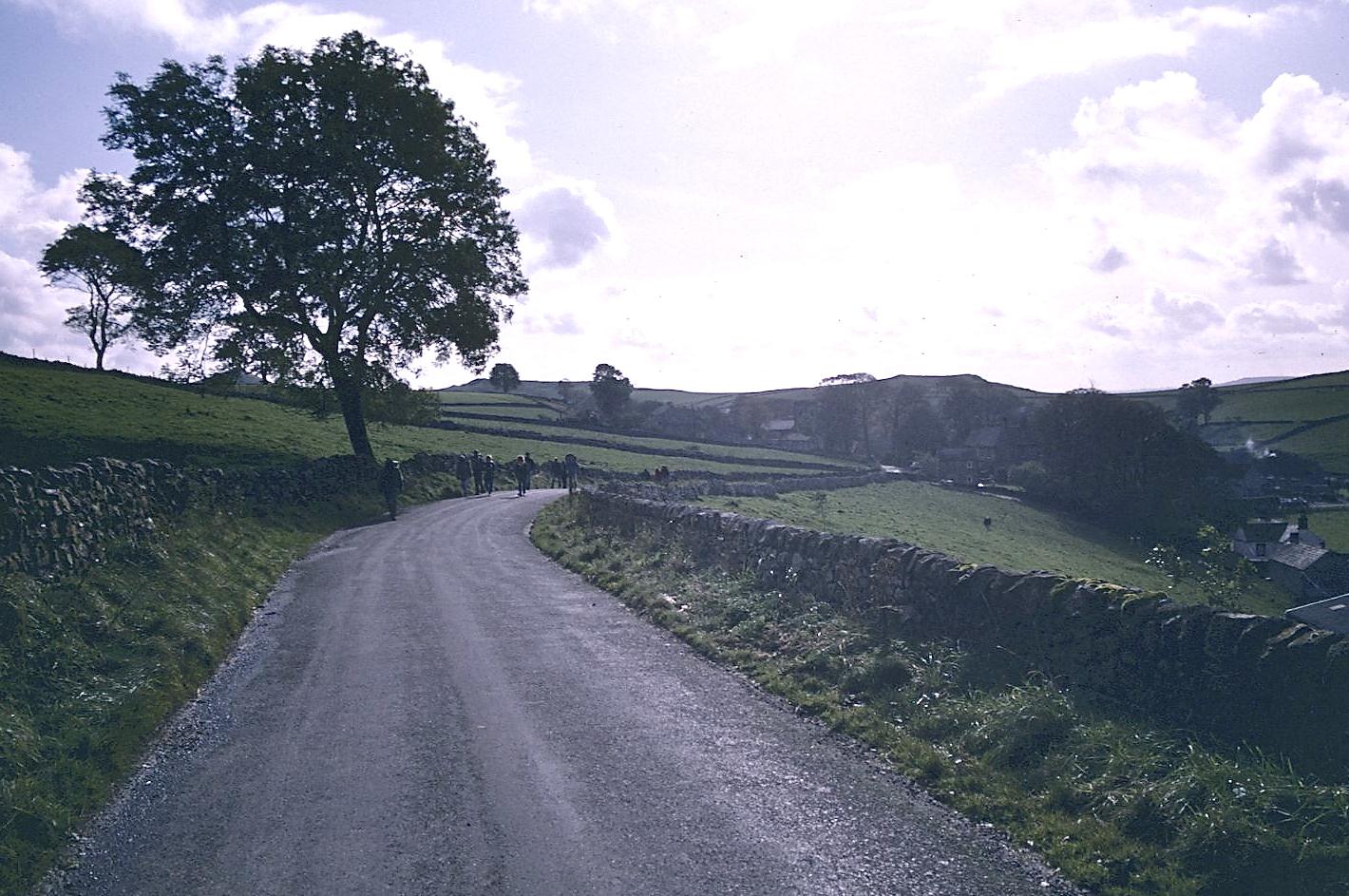
Leaving Earl Sterndale
On Wednesday, October 14, 1987, Tosh and I met once again at St. Pancras Station. We had decided, as last year, to acquit ourselves of our Alternatives responsibilities by walking on the White Peak Way. This time we would complete this 80-mile circuit of Derbyshire – one on which we had walked for four days (the half-way point) last October. It was a sunny morning in London and we were to be joined at 8:40 by twelve students (one more than last year), five girls and seven boys. I met one of the lads, Jon Pione, a senior from my U.S. Government class, as I got off the Circle Line – but Mike Messner, a tenth-grader from the same class, failed to appear altogether. We waited for him anxiously as one by one the kids emerged from the crowd to join our group near platform one. When the clock neared our 9:00 departure I sent Tosh ahead with the rest of the group in search of our seat reservations in car B. Then, having lost all hope of Mike’s arrival I climbed aboard myself and the train began its hour and forty-five minute journey north.
It was an unsettling way to begin a trip that had promised to be an outstanding one. Tosh and I were impressed with the quality of youngster enrolled for our venture this year. Several members of the hiking club, including senior Kerry Ghias and eleventh-grader Myassa Al-Malazi, were along this time, as were two members of student council, President Greg Frost, a senior, and his sister, Jenny, a tenth-grader. Most of the kids had done a good job of getting together the right equipment; only two wore tennis shoes; Tosh and I had loaned out a lot of rain equipment and packs. Whether we would see Janet’s big black pack, loaned to the missing Mike Messner, remained a mystery.
The trip seemed to go quite quickly. I spoke to all the students about the day’s itinerary and gave them advice on taping. Each was advised to use the loo once before departure. Chubby Michael Buntag, a tenth-grader from the Philippines, ate the first of innumerable Mars bars. I was somewhat concerned about this very shy boy, who sat alone opposite Tosh’s newspaper. In the event he did just fine as a walker and came out of his shell just a bit as well.
We were actually a few minutes early at Derby station. Some of the guys bought two decks of cards from the newsagent while I phoned dean Paul Fecher with news of the missing Michael Messner. I had a peek outdoors, but there was no sign of our bus driver, Mr. Sutton. He appeared only a few minutes later and loaded our packs into the boot of his huge bus. It was almost eleven and we now had a very pleasant ride, often on tiny back roads, through the Derbyshire countryside. I sat up front with Mr. Sutton, who remembered vividly the appalling weather that had ended our last walk somewhat prematurely at the Quiet Woman pub in Earl Sterndale last year. Today the weather was a mixture of cloud and sun and I was crossing my fingers that we would be able to make a good getaway before any rain. England had been experiencing some freakish weather of late; much of the South was flooded still.
We arrived in Earl Sterndale at noon and began to unload. Tosh ran up the street to fetch us some Kit-Kats. It was dry but very cold. Dizzy Kerry had forgotten to bring a hat for Myassa and so I loaned the latter my wool Mt. Sinai cap. This left me with my Tiger cap (the rainy day version) and I also found it necessary to begin the walk with my blue jacket on (another veteran of my 1977 Sinai campaign, come to think of it). Some of the girls seemed to have rather heavy packs but everyone seemed in good spirits and we were at last ready to begin the eight and a half mile trek to Ravenstor Youth Hostel.
We left in single file at 12:05 (a remarkably early start, all things considered) and wound around the back streets of the village as I searched out a path to take us to the top of the ridge above us. I was full of memories of last year’s last day, for the views were the same, and I was eager to complete this first two miles, which seemed to be full of route-finding challenges from the outset.
I left the group behind while I walked along our road in search of a steep path up the ridge. I found what I was looking for in the newly landscaped rock garden of a private house: a set of steps and a gate leading onto the open fellside. A thin trod and two stakes would have to do as evidence of a path; I whistled up the gang and they were soon overtaking me as I labored up the first of only two bits of uphill for the day. Obediently they waited for me on a track that ran along the top of the ridge. We now had a view forward all the way to the Wye Valley, with the immediate foreground dominated by the mammoth pits and spoil heaps of a limestone quarry. Indeed there were ominous signs posted hereabouts – warning us of the sirens used to announce blast-off, but, though we heard the wail of the sirens several times, we never seemed to be very close to the explosions.
We followed the track in a northwesterly direction while I searched for the turn-off promised by Robert Haslam in his book, The White Peak Way. I had a xerox of the correct page and part of the Ordnance Survey map as well in my plastic map case. This OS xerox proved to be quite a useful guide to the twists and turns through fields and along fences required by this route – as we now left the track and headed in a northeasterly direction toward the A515. Doug Gibb, one of the twins of my colleague Livvy Gibb, was my companion during this stretch. The last time I had had a conversation with him was when he was an impish eighth-grader in my English class. Now he was a very mature and good-humored senior. I soon gave up on my attempt to use his young eyes to spy out useful landmarks. He had abandoned his usual eyeglasses, was not wearing his contacts, and could see about as well as Tosh.
I easily found all the turnoffs indicated in the guidebook and signaled on the map. We crossed over a railway line and entered a very muddy farm lane. Jon, walking in Adidas instead of boots, discovered an impromptu path along the bank above the puddles and we all took to this greasy hillside in an attempt to keep the feet dry. It was tough going but we at last outdistanced the mud and emerged at the head of the lane next to an electrified wire (which several of the students tested with no ill-effect.) We now had a turn off through Brierlow Grange farmyard; I was astonished to see that there was a small store here – but we were not yet ready for ice lollies. We continued onto the highway, where I reminded everyone about single file. In less than a hundred yards we had reached a stile that allowed access to a large field. Below us I could see Horseshoe Dale and the route to the Wye. We still had a good deal of sun and had covered the first two miles in an hour. Earl Sterndale already seemed to belong to another time and London to another planet.
There seemed to be no path down to Horseshoe Dale; I took a compass reading and headed northeast. As we got near the bottom of the field I could see our road and some farm buildings but no gate through the stone wall. This took some figuring. Finally I decided to hop over the wall at a low point; this enabled us to scramble over to a gate onto the road. Kerry complained good-naturedly in her little girl’s voice that I had been unfair to people with short legs. She was also suffering from the bite of a recent nettle bush. I shouted back to Greg Frost some instructions on closing the gates behind us. Greg was walking with Tosh at the rear, his fuzzy Russian commissar’s cap decorated with a souvenir red star.
Horseshoe Dale had soon enclosed us in a deep canyon, somewhat more protected from the chill wind. Doug, Jon, and tenth-grader Nat Bradley took turns finding the driest path through this valley bottom, which was quite wet and slippery. After Back Dale made its appearance on the left we began to encounter scree and stones as well – altogether not a pleasant surface. I could never figure out how Jon and eleventh-grade Chris (for Christine) Prather managed to do it in tennies. At the three and a half mile mark we reached the mouth of Thirst House Cave. Here I had promised a lunch stop. To my surprise the kids had not already eaten all their food on the train and everyone now tucked in. Myassa and Kerry went back up the valley a bit to take photos (or perhaps this was a cigarette break); throughout the trip these old friends tended to remain slightly apart from the rest of the group, but no one took it amiss. I ate one of the sandwiches I had made this morning and Michael Buntag ate another Mars bar while working on a drawing assignment for his Art class. There was still a bit of a wind and no one minded my suggestion that we get moving again without too long a delay. I was just grateful that the cave did not have to serve as a rain shelter.
We took off when Kerry and Myassa returned. The footing remained tricky for another mile and we scrambled down Deep Dale, fighting our way over scree and boulders, under foliage and around muck piles. At last we emerged on surer ground at the slurry pond of the Topley Pike Quarry, somewhat ruinous in its cloud of wind-blown dust. A path lead us by the works and out to a road through the Wye Valley. I paused here briefly to take my jacket off. It was becoming overcast but warmer at the same time. We crossed the road and started to follow a bridle trail along the river. There were suddenly other people about, including a family loading wood into their old blue banger.
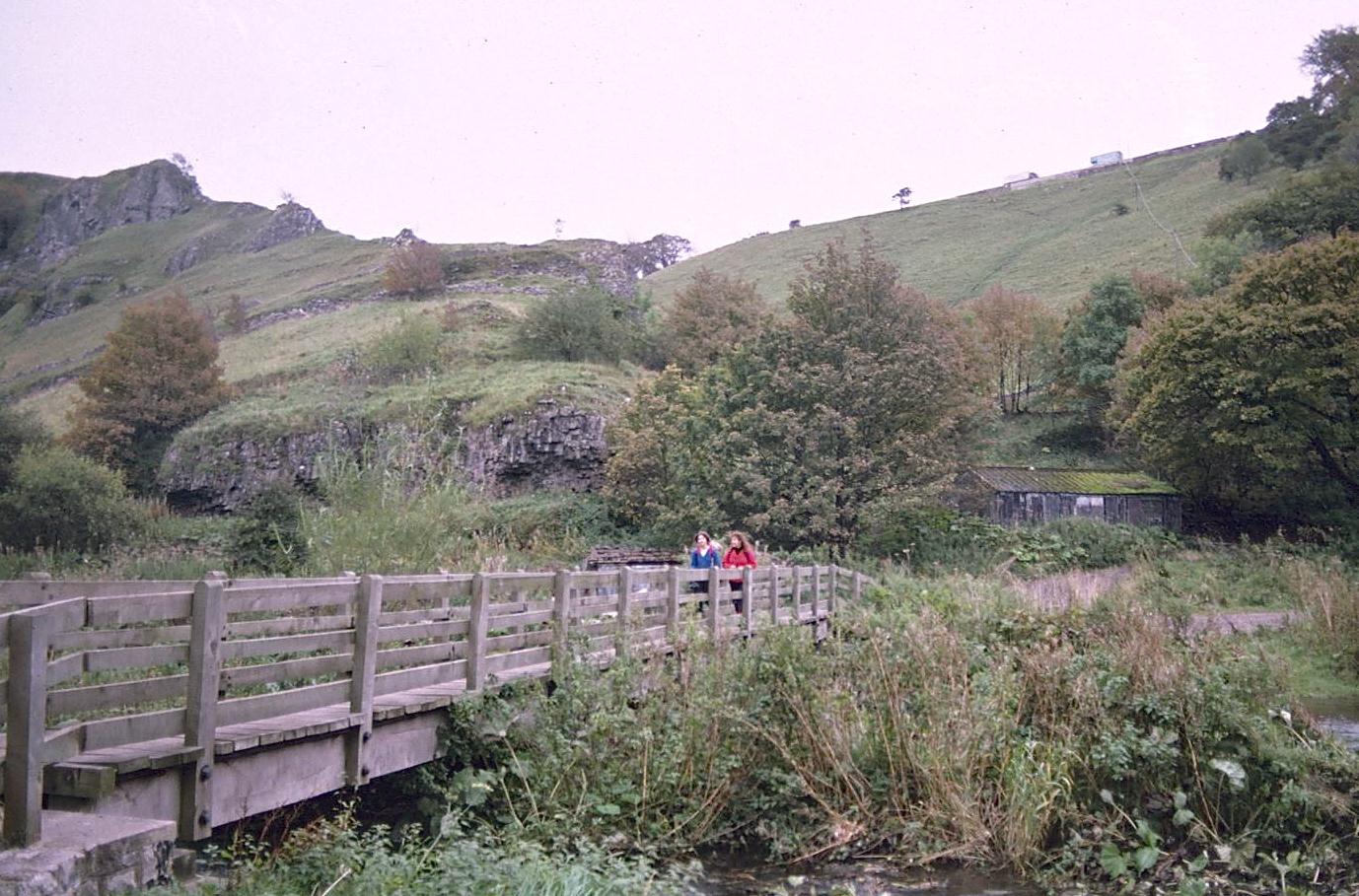
Kerry and Myassa in Chee Dale
Part of our route now coincided with the Monsal Trail, a route that seemed to be following in the tracks of some old railway lines, and it wasn’t always easy to resist its turnoffs in favor of the White Peak Way. Fortunately I had discovered, by accident, a Mark Richards guidebook, White Peak Walks, The Northern Dales, only the previous day at Foyle’s. Some three-quarters of the WPW was covered by one or more of Richard’s day walks and he had provided excellent Wainwright-style maps – which I found very useful. Richards, too, found a place in my map case.
The Wye accompanied us for almost four miles, the second half of the afternoon’s jaunt. We crossed the river several times on footbridges and often we walked beneath the spans of railway viaducts. Sometimes the river seemed placid and gray; at other times it ran swiftly over rocks. There were even tunnels for us to negotiate. In all, it was quite easy walking on broad tracks for several miles and it was hard for me to keep up with the guys, let alone some of the girls – like pretty tenth-grader Dina Hammam, who seemed to be a delightful target for teasing. (Dina was the first of the three Hammam children whom I would get to know well over the next few years; their father, of course, was Sam Hammam, better known as the owner of Wimbledon and later Cardiff City Football Clubs.)
We had just cleared a second tunnel and crossed over the river on a large bridge when the road disappeared into the mouth of a sealed tunnel and the path seemed to retreat upstream – in the same direction from which we had come, though on the opposite bank of the river. It was time for a rest anyway, so some of us sprawled out with our backs to the bridge abutment while others were sent downhill to see if the path continued downstream as well. These kids reported a fork at the streamside and so, after about ten minutes, we returned to the river, crossed under our bridge and found a footbridge that allowed us to continue downstream on the opposite shore. The only problem was that after a short distance this path plunged into the water itself! Next to the cliff face on our left a series of stepping stones had been provided but in the high waters produced by all the recent rain these stones could be seen disappearing beneath the surface of the river as they rounded a corner hidden from our view.
What to do? I considered all the options for alternate routes out of Chee Dale while the rest of the group caught up, grasped the problem, and began to giggle. Paul Herzog, our one veteran from last year, a soft-spoken bespectacled eleventh-grader, decided to have a look along the stones. He waded forward, evidently able to stand even on those underwater, and waved us forward when he got to the bend. I shouted questions, but the water drowned out his answer. So we decided to follow him. I had my walking stick again, and could use this for balance. Also our left arms had the security of the cliff face for balance. In great excitement we crept forward from stone to stone. At the corner it was possible to see that only a few more steps would bring us back to shore. The kids were greatly excited by this adventure and we all made it safely. Some photos were taken and the drops shaken from our boots; no one reported taking in any water.
We never had to get quite this close to the Wye again, though the path chose some rocky ascents to get us away from the river on several occasions. I was worrying about the crossing of an “unbridged tributary,” but when we reached it we discovered a bridge after all – and only mud slowed our progress. Kids were beginning to ask me how much farther we had to go, but it was hard to give precise figures without outstanding landmarks. We emerged at last into a more open area and passed some fishermen. A metal bridge gave me the chance to pinpoint our location. It was a guide to the next day’s route and while others caught up I had a look around in order to discover, hidden by foliage, the beginning of the path up to Wormhill.
We continued downstream for another mile on leaf-covered paths in the late afternoon darkness of a gloomy October day. The kids all seemed to be doing well, in spite of the questions about how much longer. Only Jenny Frost seemed to be having footwear problems, the result of having borrowed someone else’s boots. Even she, however, was her usual chirpy good-natured best, the braces on her teeth failing to disguise the beginnings of a very pretty face.
We started to hear the sound of motor vehicles and even before I expected it we were arrived in Miller’s Dale. Some of the girls went to a nearby loo while some guys in a pickup truck interviewed me on places to walk. Then we started on a mile-long section of road walking, through the hamlet of Miller’s Dale, with a church on our left and the Angler’s Rest pub on our right. I decided to follow the Tideswell road up the hill (our second and last stretch uphill), with sidewalks accompanying us for some distance. I must say that my left leg was complaining with every step now, but somehow I managed to keep going.
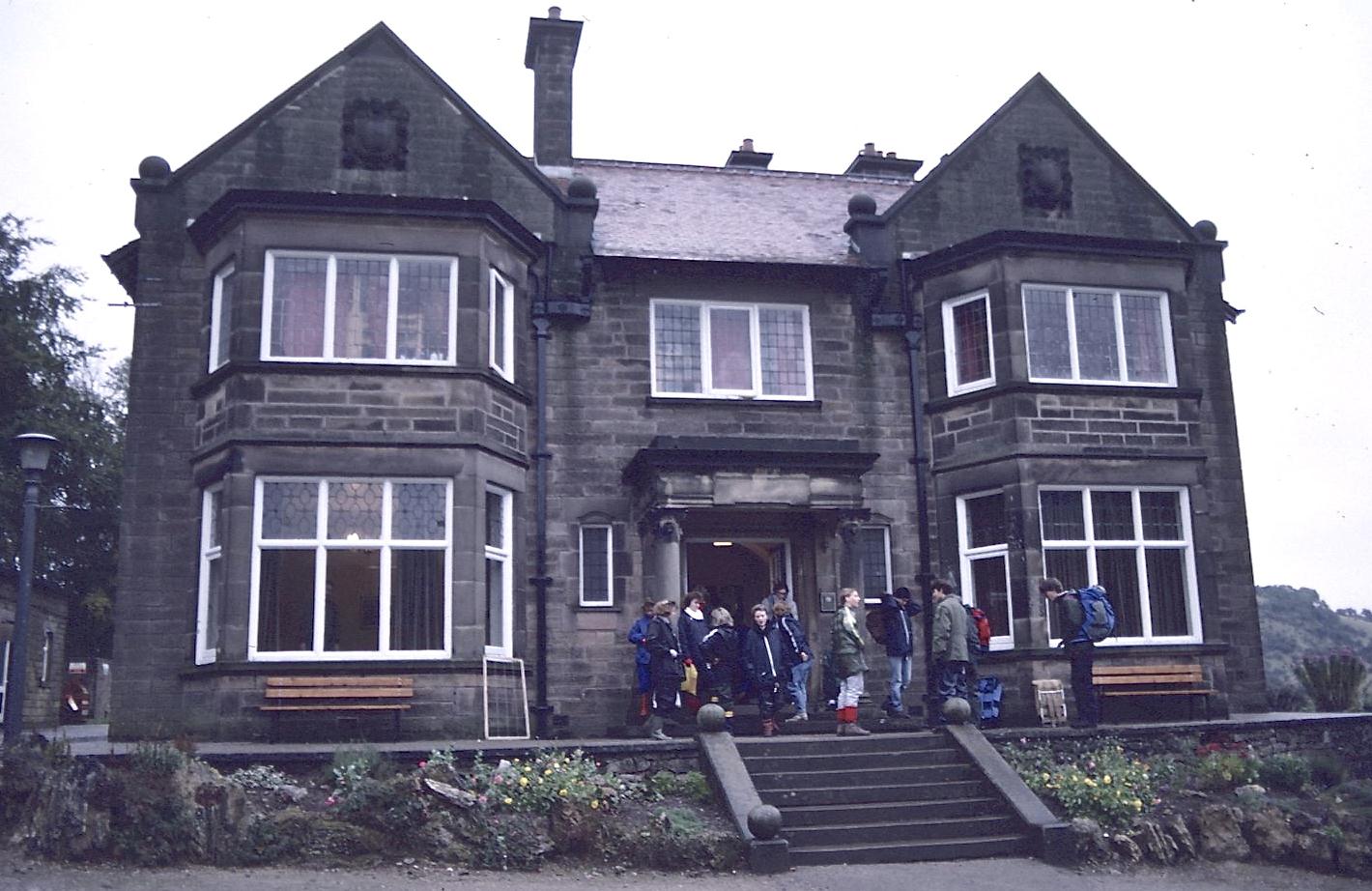
Ravenstor Youth Hostel.
I used a version of this photo as an illustration in A Walker’s Alphabet.
The access drive to the Youth Hostel headed off to the right, after only a few minutes, and we were able to escape the road at last. At the end of the drive we came across the former mill owner’s house that now served as Ravenstor Youth Hostel and there, on the steps, waiting for us, was the missing Mike Messner! This tall chap had gone, with the help of his insistent father, to Euston instead of St. Pancras. After an hour of fruitless waiting they had returned home and re-read their instructions. Mike had phoned the Youth Hostel to get directions, returned to St. Pancras and traveled by himself to Chesterfield and by bus to the hostel. I was not only relieved to see him but quite proud of his initiative. Later his mother told me that she had let him go with great trepidation – but that the experience had been immensely useful to his self-confidence.
With Mike as our guide, we checked in. Our boots were left in a boot room near the front door. No one needed any paper stuffed in shoes tonight. A friendly chap had me sign in and gave me information about our duties and our dinner selections. It became one of my rolls to canvass all the rest on their choice of starters, entrees, and desserts before we sat down, and, while we were eating, similar choices affecting the breakfast menu. I did the first canvassing while our people were still assembled on the front porch taking off their shoes. We were now sent up to dorms on the first floor. Our group did not have to share accommodation with anyone else. The eight men had a delightful long room with wonderful views of the Wye Valley in two directions.
Nat Bradley and Jon Pione made it to the showers; they were soon back with wet hair, Nat’s a glistening black, Jon a washed out blonde. The senior, a pale Southern California youth from Palos Verdes, seemed to serve as role model for the younger Nat, which was just as well for I knew least about Nat – who had missed part of our orientation meeting because he had to get to his guitar lesson. Nat’s deodorant spray was puffing away as I directed Doug Gibb in the treatment of a nasty blister. Michael Buntag, who seemed tired but intact, ate a candy bar. Everyone else seemed to have survived day one well, though red-headed Chris asked for some help for a headache and chose two Excedrin from the array of medicaments available in my suicide kit.
Dinner was at 7:00. I had time to speak to Dorothy by telephone and Tosh fixed us some coffee from sachets purchased at the reception desk. In fact she bought quite a few of these and we showed Kerry and Myassa how to make coffee in the member’s kitchen. I cannot say I approved of the sign informing us that Ravenstor had a license to serve alcohol with meals, but no one seemed to order any – from our group I expected no trouble, but there was another large school party with four teachers and twenty-seven fifth-formers on a geography outing. They were actually quite a wholesome lot, but very noisy – as we discovered when the hubbub began at mealtime. Someone from each table was delegated to do the serving. A vegetarian entree was offered but I don’t think Dina or Myassa took it – the selective vegetarianism of these teenage girls always baffled me.
At the end of the meal quite a few members of our group stayed behind to help with the cleaning up. The two Michaels then set the breakfast table. The Hostel had a nice quiet room with a roaring fire and a games room with several pool tables. Our kids came by to inform us that they were going outside a few times, but it was pitch black out there and it began to drizzle so there was not much mischief to get into. Cards and chess were played in front of the fire and some of the kids danced to a jukebox in the games room when the pool tables were moved out. Handsome Greg was much in demand at this dance, particularly among the local fifth-formers, but he was playing hard to get.
Tosh struggled sleepily with A Tale of Two Cities and tried to phone Harold on a machine that would only accept one coin in four. We had him phone Paul Fecher with the news of Mike’s arrival. I tried to get our lot to bed at eleven, but it was a struggle since there were still so many kids from the other school darting about and playing games on our landing. I took a sleeping pill and plugged in my walkman. Shortly after eleven-fifteen the last of our lads turned off the lights and we all went to sleep without difficulty.
To continue with the next stage of our walk you need: