
September 21, 1997: Cooling to Strood
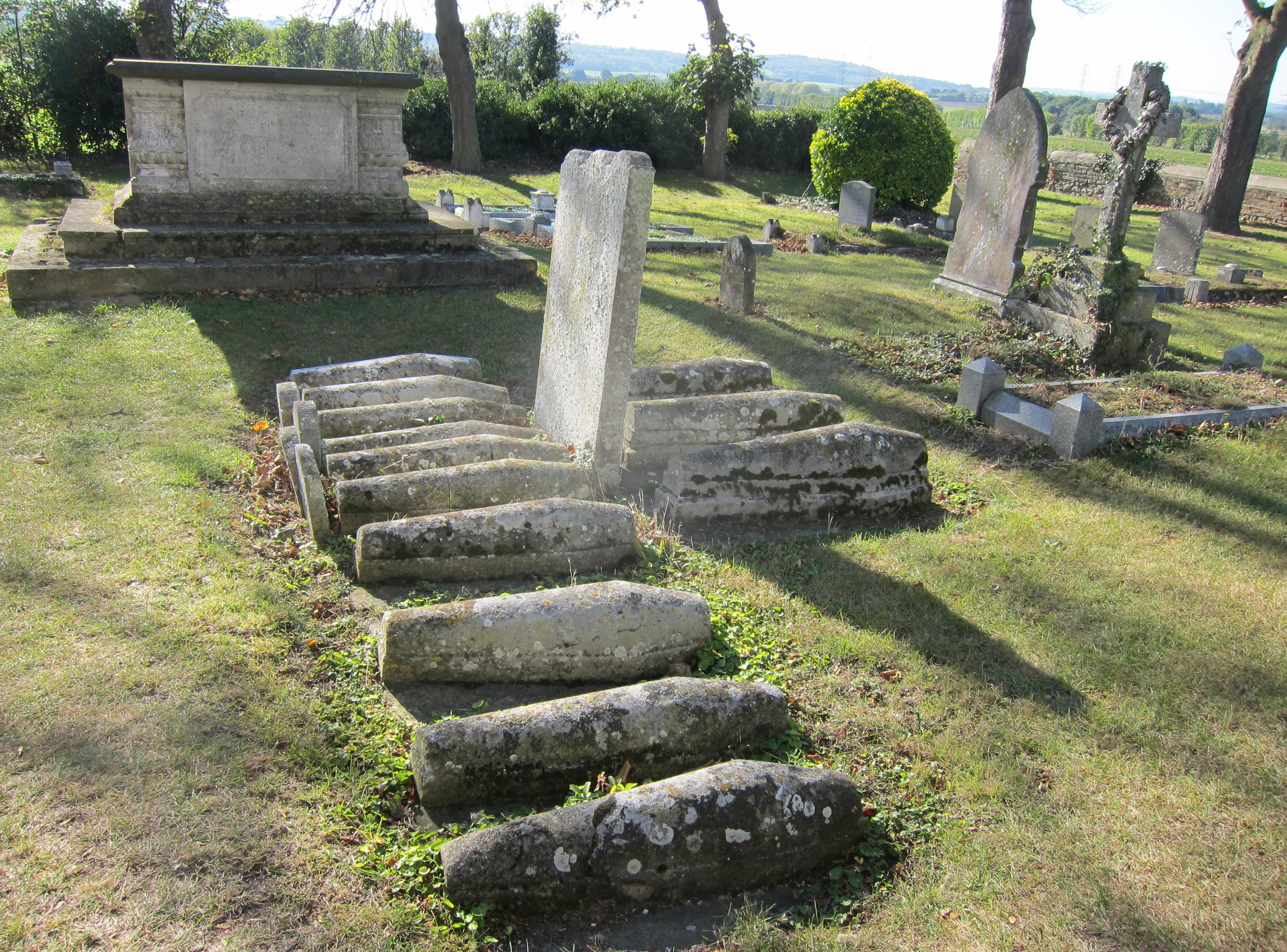
In Cooling churchyard
The Lees and I chose a beautiful autumn equinox day to continue our walk along the Saxon Shore Way. We met at about 9:15 in Charing Cross, hurried through ticket purchase, got in the snack and coffee queues, and hopped aboard the 9:23 for Strood. I dominated the conversation in the one hour it took us to get to our destination – bringing my friends up to date on all the matters that had been weighing heavily since the beginning of the fall term, the affairs of the English department, the launch of student council and the school newspaper, and some new signs of progress in the major works program of our mansion block. They could tell just how much I needed a day in the countryside to recover some sanity. The journey was without incident except that, only a short distance from our starting point, I did see a fox atop a brick garden wall, staring brazenly at the speeding train.
There were no taxis in front of Strood Station (just a “queue here” sign) and the phone number I had copied down last time didn’t work – so the stationmaster suggested we walk down to the high street and try our luck there. Tosh forgot her sunglasses in the telephone kiosk but a West Indian chap called her back before we had gotten too far down the station access road. No sooner had we rounded its corner than a cab came by and Tosh darted back to see if he was free. He was, though her request for a ride to Pooling instead of Cooling had him quite confused. The ride turned out to be a major expedition – as the main road to Cliffe had been closed and we were required to cover a great deal of additional territory to get where we wanted to go. Our cabman was a jolly smoking much-tattooed fellow who gave us a running commentary on the countryside as we slowly approached Cooling Castle and our final destination, the churchyard of St. James’ church.
Since our last walk I had revisited the opening scenes of David Lean’s version of Great Expectations. In the novel Pip refers to the five lozenge-shaped tombs of his dead brothers but there are in fact thirteen of these odd memorials here; I took some pictures for Tosh and we had a look inside the simple church – it was Sunday morning but there were no longer any regular services here. It must have been shortly before 11:00 that we pulled on all our gear and found a little track to the south of the church. We were ready for our walk.
After strolling behind some back yards the excellently waymarked route put us onto the tarmac of the village’s main street. We passed the Horseshoe & Castle (not the Castle & Horseshoe, as Bea Cowan would have it in her excellent guide) and headed east on a twisting road full of cyclists and whizzing cars. Eventually we were invited to take to a farm track through a pear orchard. Here Tosh picked up a piece of windfall fruit. We passed Bromhey and Eastborough Farms and just before a radio mast we were invited to take to a grassy ride next to a hedgerow and cross through some marshy territory over two bridges at the foot of Northward Hill. It had been a bit on the cool side to this point, with some wind, but as we began our only steep ascent of the day, layers came off. When we paused to sit on a bench at a nice viewpoint, Tosh borrowed my Swiss Army knife to cut the windfall pear into pieces for the rest of us.
After a nice rest we continued though the woods, an RSPB sanctuary. We did not hear the promised nightingale sing. There were some twitchers about but we never saw any other genuine walkers on this day. Eventually a descent lead us out to fields to the north of High Halstow and, with a view of the church tower in St. Mary’s Hoo (now a private residence according to the guidebook), we reached Decoy Hill Road, using its tarmac to round a corner before heading east on a recently ploughed field – with little evidence of path. Bessie’s Lane was supposed to be a “delightful green lane,” but it was just an overgrown ditch as far as we could tell. Nevertheless we turned south here and this became the dominant line of march for the rest of the afternoon. We were making very good time, not pausing at all, and keeping up a corking pace. It was as if the body demanded some vigorous movement after weeks of enforced indolence.
We emerged from Bessie’s Lane at Fenn Street and used roads for a bit, pausing once at a service station so Tosh cold use the loo and (dutifully) purchase a candy bar to show the accommodating attendant that she was a genuine customer –and not a freeloader. While she was inside Harold and I got into a conversation about the name of the sports teams at Grinnell College (Tosh was wearing her alma mater’s scarlet and black cap). Neither Harold nor Tosh was sure of the right answer, though I was sure that the Cyclones (Iowa State), Tosh’s nomination, was not the correct answer. Eventually Harold, after a period of painful cogitation, came up with the right moniker – The Pioneers.
We left the service station and wandered behind back fences and along hedgerows, looking for a good spot for a bit of lunch. I found a nice open space in the sun on the opposite side of a line of trees and we sprawled out on the grass for a pleasant repast, protected from the wind. Dorothy had purchased some pre-packaged sandwiches for me at Sainsbury’s (I didn’t care much for the Greek Salad Sandwich), and there were also some fiery Indonesian prawn crackers. It was shortly after 1:00 when we packed up again and continued our march southward – with improving views of the Medway estuary on our left.
We traveled down Roper’s Green Lane, over a mineral railway line and onto a road. For once the Saxon Shore Way signs failed us and, after passing a tiny lake presided over by a solitary swan, I had to spend some time trying to figure out where we were. In the event I decided we were still on route, but it was time to head east again past a radio mast and across Stoke Road. Our immediate objective was Hoo St. Werburgh, a very sizable community whose church tower was to be our beacon for some time. To reach the road that skirted the town we chose to use the official line of the walk and cut a corner across a deeply furrowed, just-ploughed field, with no evidence of any other walker’s footprints. It was shortly after 2:00 but we figured there must be a pub still open. Right behind the church we found the Bridge Tavern, entering its smoky saloon bar to sit down and have a leisurely half lager each.
Then we visited the churchyard (the Lees headed out of this space in the wrong direction and I had to call them back). We walked on farm roads for quite some time now, climbing the hill to pass Cockham Farm and the woods adjacent to Hoo Lodge. I picked up a giant conker, just hatched from its husk. When we reached Elm Road we turned down a suburban cul-de-sac and sat for a while on a wooden bench with views of Rochester’s cathedral and Norman Castle. This was a lovely resting spot, with squirrels, conker-hunting kids and dogs out for walkies. The sun was still warm and it seemed that we were always walking into its smiling face today.
For a while there was a descent through woodland (Harold was reminded of our jaunt in the Landslip this last summer), emerging at last at Lower Upnor (if this isn’t a contradiction in terms). Here we actually walked along the shore of the Medway for a short distance, then onto a road choked with Sunday traffic, escaping this to climb a hill on steps behind the walls of Upnor Castle. A delightful but miniature High Street could then be followed downhill to the water’s edge again, but soon we were driven inland (not much shore on the Saxon Shore Way today) along tracks and dirt roads in seedy substandard countryside, past the sewage works, past an ancient tottering long-haired Jack Russell, across a highway near a roundabout, and uphill to Upnor Road.
I was out in front now, seeing a chance to make the 4:25 train from Strood Station and trying to keep up a rapid pace. Views were extensive as we descended on a tarmac path down the face of an old quarry, but soon we were in industrial backwaters (including a canal crossing) and a scrap-sided back street. But when the Riverside Tavern appeared on our left I knew we had only one more turn-off to go. We approached Stood Station, by this time locked up, and found the right platform for Charing Cross trains. I thirstily drank another carton of strawberry juice and had just finished it when our train pulled in. We had made it.
Each of us slept a good deal of the way back – even I dozed off for about half an hour. The train made innumerable stops in seamy south London; whole gangs of young people got on, some with baby carriages. One chap had a huge spider web tattooed on his face and a tuft of dyed blonde hair under his cap – another triumph of appearance over substance.
The day’s outing had been a great success, stimulating and relaxing at the same time, and we were already planning to continue the walk the following weekend. I climbed aboard a Bakerloo train shortly before 6:00 and by 6:30 I had regained my home base – where Dorothy was coming down with a cold.
To continue with the next stage of our walk you need: